| Mar 03 |
Filled under: Heroines and heroes, Myths, legends, folklore, Picture Books, Research, Uncategorized, Writing | by laridon |
It’s March, and I have a new book out this month! 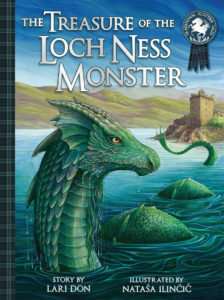
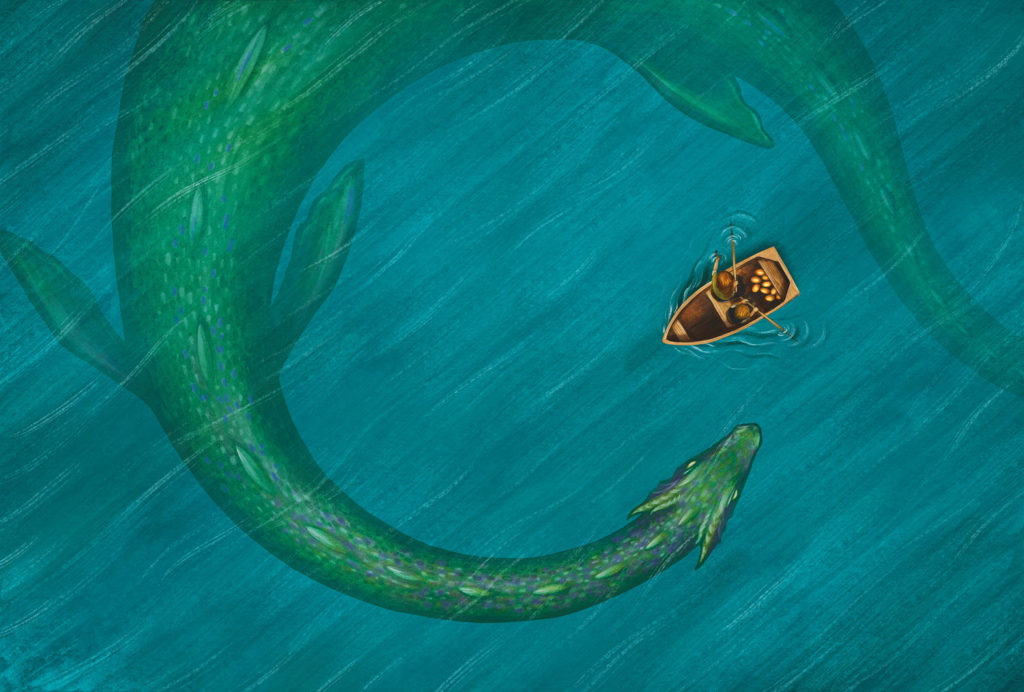
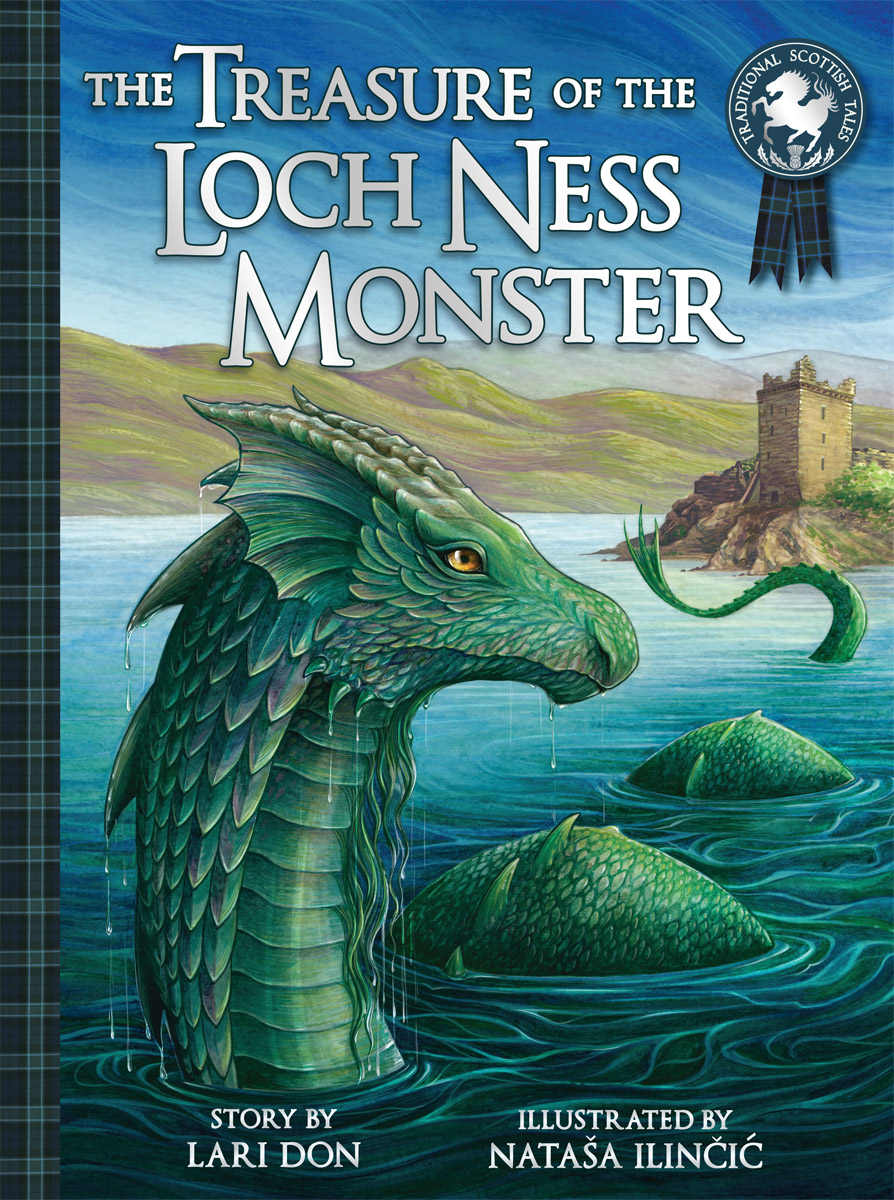
I’m really excited about The Treasure of the Loch Ness Monster. It’s a picture book inspired by traditional Loch Ness folklore, with wonderful illustrations by the amazing Natasa Ilincic.
I admit that this is not a book I ever thought I would write (though I could say that about most of my books!) I’ve lived near Loch Ness, but I’ve never seen a monster there, and I’m not sure I’ve ever believed in a monster either.
But I do believe in the power of stories. And I’m a big fan of questions too… Does Nessie exist? If she did exist what would she look like, what would she care about, what would she want, what would she prepared to do to get it? If you met Nessie how would you react and what would happen next? (These are the sorts of questions I ask about all my characters, whether they are huge and green or not.)
I’ve had the opportunity to explore all those questions and more in this picture book. I also did lots of folklore research, which I love.
This book is a companion to The Tale of Tam Linn and The Secret of the Kelpie, as part of Floris Books Traditional Scottish Tales range, but it presented very different problems.
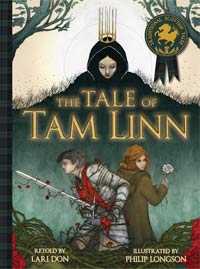 The Tale of Tam Linn is based on one Borders folktale. There are many versions of the tale of Janet and Tam Linn, but the heart of the story is always the same. So my challenge was to find the best way to retell that story for a picture book. The Tale of Tam Linn is based on one Borders folktale. There are many versions of the tale of Janet and Tam Linn, but the heart of the story is always the same. So my challenge was to find the best way to retell that story for a picture book.
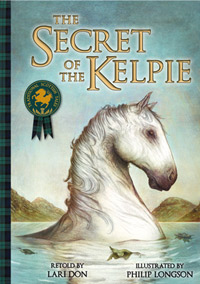 There are lots of different kelpie folktales from all over Scotland, so for The Secret of The Kelpie my challenge was to create a new story that reflected lots of different bits of kelpie lore. There are lots of different kelpie folktales from all over Scotland, so for The Secret of The Kelpie my challenge was to create a new story that reflected lots of different bits of kelpie lore.
But as soon as I started to discuss a Nessie book with my wonderful editor, Eleanor, I banged up against one great big monster-sized problem. There isn’t a Nessie myth or legend or folktale. There is an old story, from more than a thousand years ago, about a saint driving away a water monster in the loch, but that monster had just eaten a local man, so I don’t think that’s the Nessie we know and love.
There are lots of glimpses and partial sightings of Nessie, lots of rumours and mysteries about her. But there is no authentic, full-length, story-shaped traditional tale.
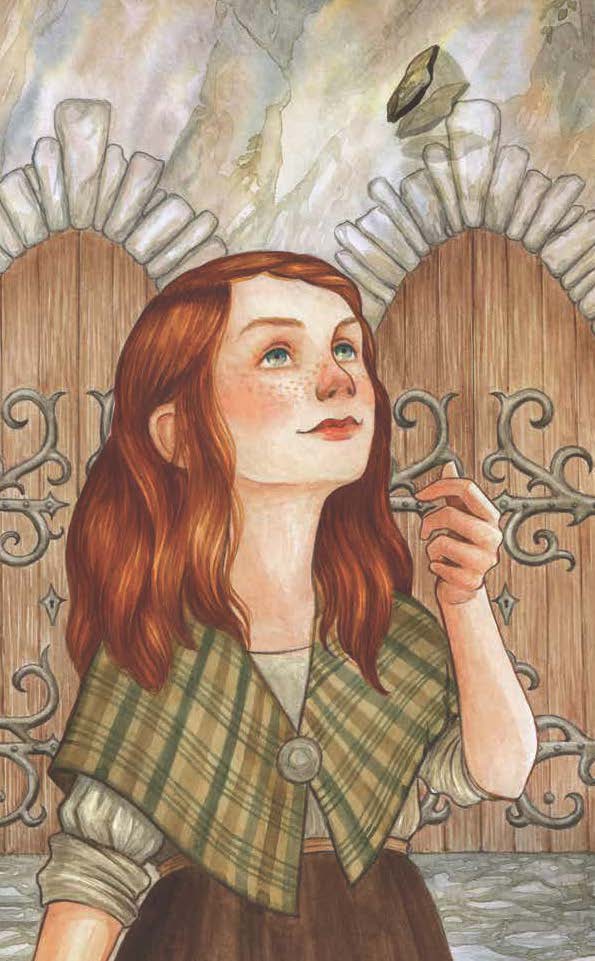
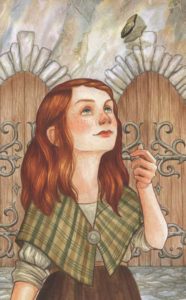 So, I started reading more widely (getting to read lots as part of your job is one of the best things about being a writer) and I found a little snippet of folklore about treasure under the castle overlooking Loch Ness. I started to wonder about that treasure and the magic guarding it, and what Nessie’s connection might be to the treasure. Then I started to imagine some children who were prepared to take risks to get that treasure. So, I started reading more widely (getting to read lots as part of your job is one of the best things about being a writer) and I found a little snippet of folklore about treasure under the castle overlooking Loch Ness. I started to wonder about that treasure and the magic guarding it, and what Nessie’s connection might be to the treasure. Then I started to imagine some children who were prepared to take risks to get that treasure.
And that’s when I had a story. A mysterious monster, a dangerous treasure? Both of those were great. But it wasn’t until I met Ishbel and Kenneth that I had a story I wanted to tell. 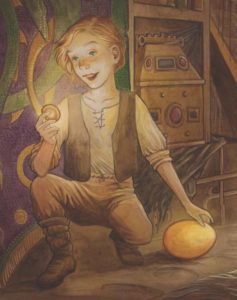
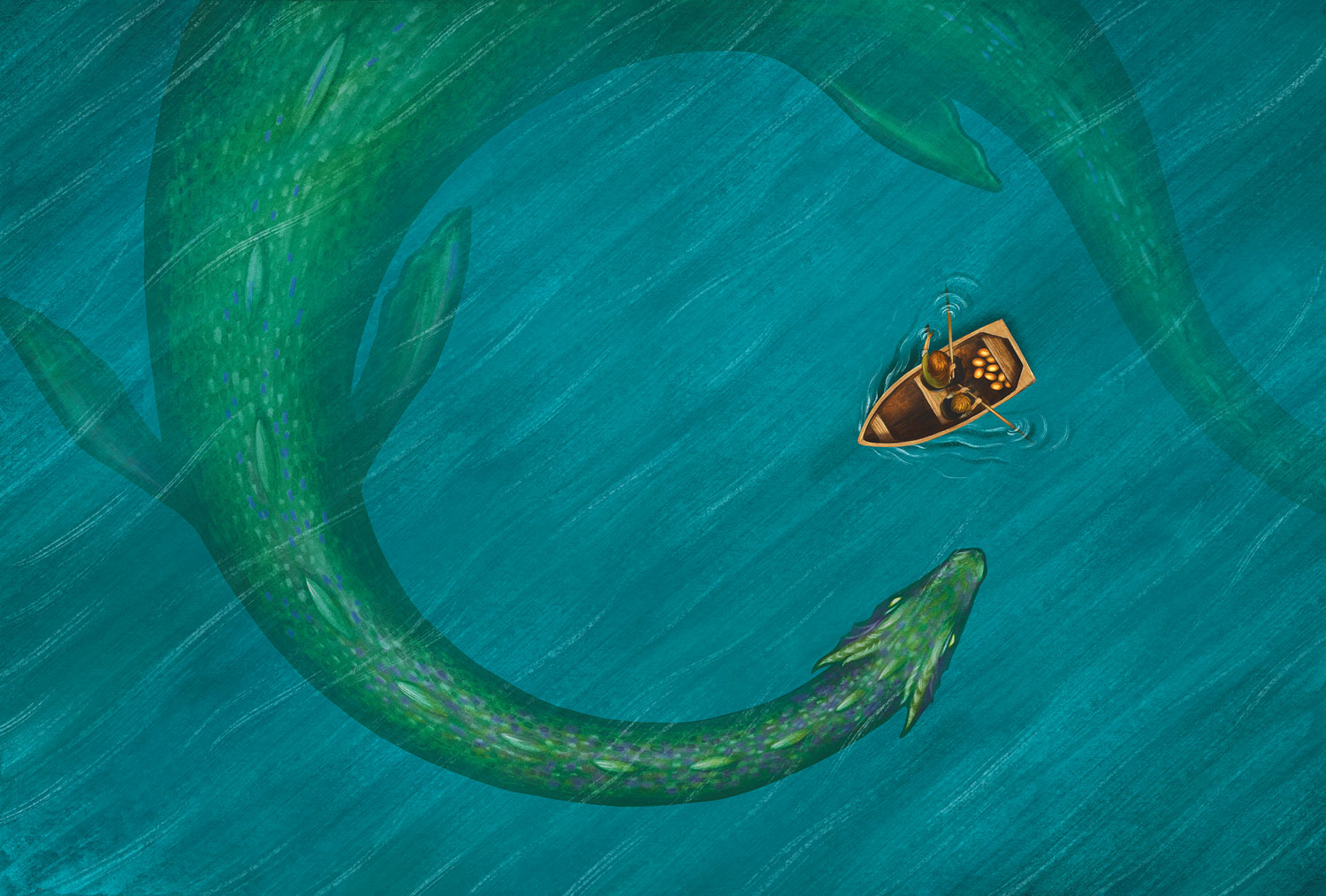
I also met Natasa. (She’s real: I met her in a café; Ishbel and Kenneth aren’t real: I met them in my head.) Natasa is a wonderful, magical, wise artist. She has created a classically beautiful Nessie, but also given Kenneth and Ishbel all the character and cheekiness and courage that I could have hoped for. (And she has created the most amazing treasure chamber ever!)
And you don’t have to wait very long to meet Natasa’s Nessie, go on an adventure with Ishbel and Kenneth, and find out all about The Treasure of the Loch Ness Monster!
The book is published on the 22nd of March, and you’ll be able to find it or order it in all good bookshops and libraries.
And I’d love to know what you think of it!
|
| Jan 14 |
Filled under: Fabled Beast Chronicles, Heroines and heroes, Myths, legends, folklore, Novels, Readers, Spellchasers trilogy, trilogy, Uncategorized, Writing | by laridon |
I ask my characters difficult questions all the time: ‘how are you going to get out of this trap, how are you going to defeat this monster, who do you trust, what kind of magic user do you want to be…?’ So I thought it would only be fair to let the main Spellchasers characters ask me a couple of awkward questions in return.
(nb – I’ve tried not to give away too many spoilers, but if you don’t like to know too much about a book before you read it, you should probably read the Spellchasers trilogy before you read this post)
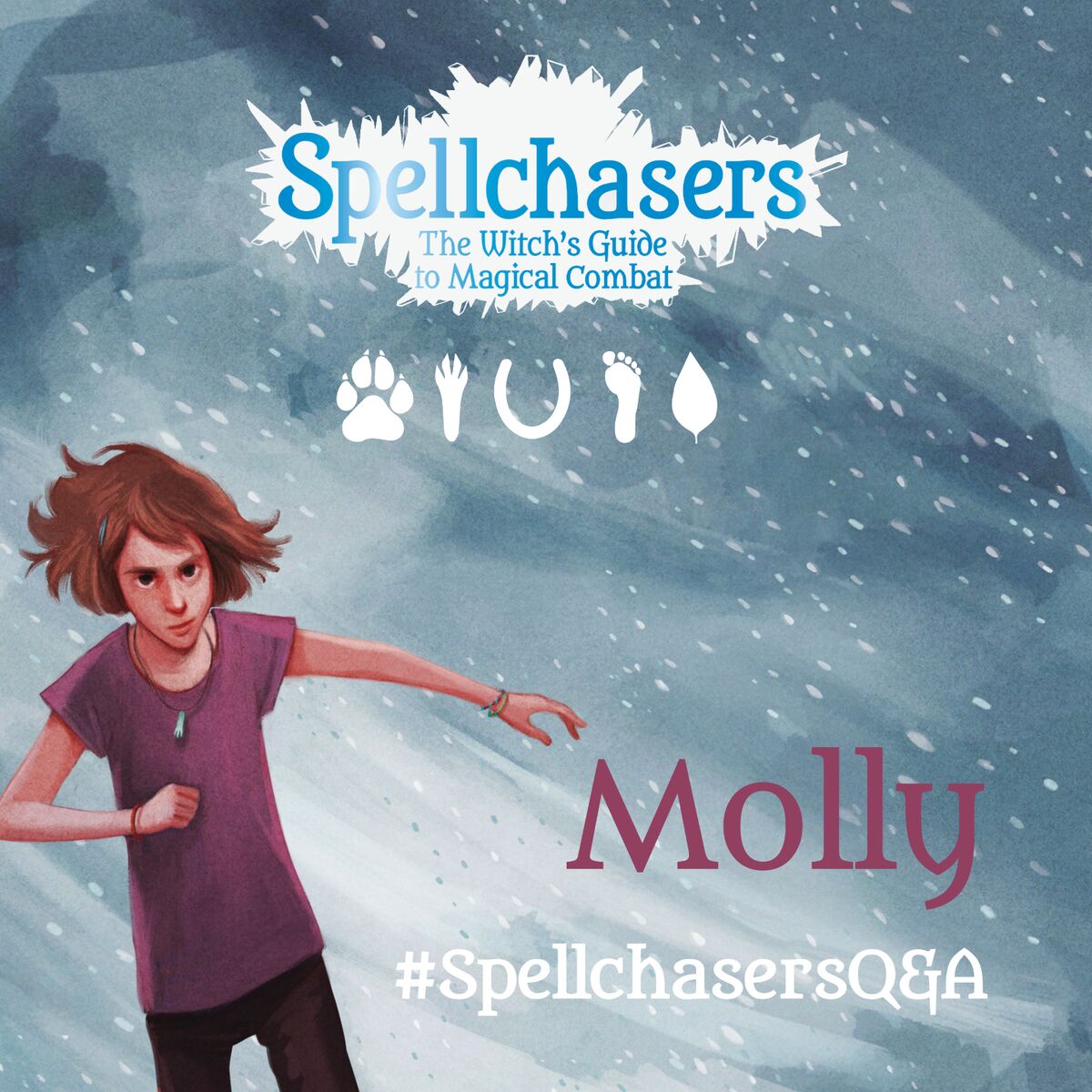
Molly
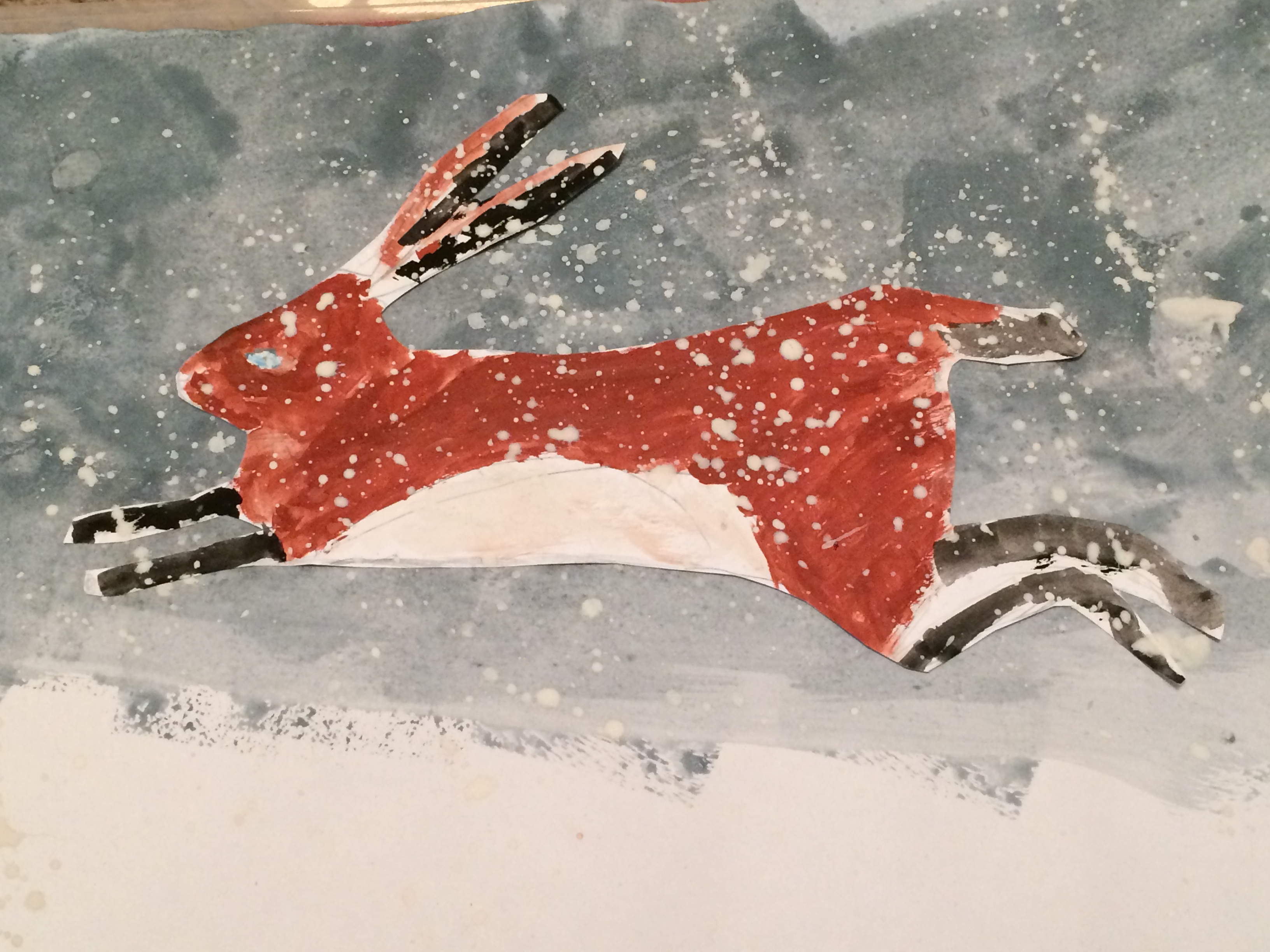
Q – Why did you choose to turn me into a small vulnerable hare?
A – Hares are beautiful, fast and very hard to catch. Also, there are lots of old stories from the north of Scotland about women transforming into hares, so it felt authentic. Finally, the witch who cursed you was obsessed with dogs, so it made sense for him to turn you into something that dogs like to chase. Is there an animal you’d have preferred to be? Mouse, snake, goat, worm, perhaps?
Q – Why did Beth dislike me so much when she first met me?
A – She was afraid you would slow the curse-lifting workshop down, and prevent her lifting her own curse. She has never really trusted humans, because humans can be very damaging to trees. Also, to be honest, Beth can be quite grumpy at times. I suspect she doesn’t make friends easily. (Just ask Snib…)
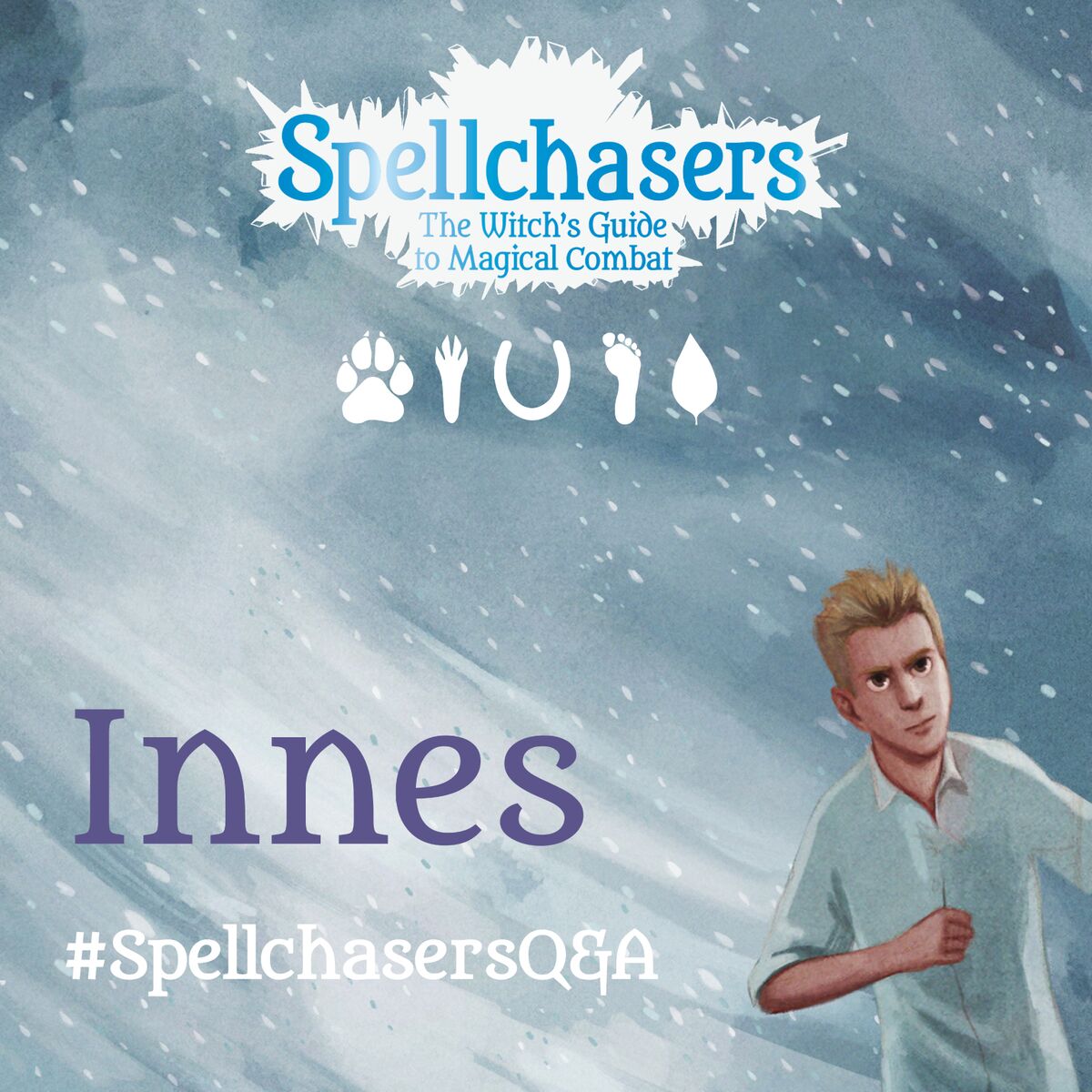
Innes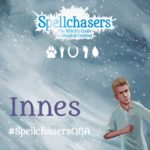
Q – Why are you so negative about kelpies eating their natural diet of human beings?
A – Because I’m a human being, and so are all my family and friends who live near your rivers! (Here, have a biscuit…)
Q – Am I the hero of this story? I’m the best warrior, so I should be the hero!
A – It’s Molly’s story… And you all work as a team (some of the time, anyway) so it’s not about one of you being more of the hero than anyone else. But you all get to be the heroes and heroines of your own subplots and your own part of the huge battle at the end.
Q – Do I ever get to beat Molly in a race?
A – Probably not! Perhaps the only way you’ll ever beat her is to see if she can shapeshift into a horse, and race as exactly the same animals. Or you could challenge her to an underwater race?
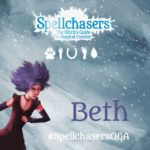
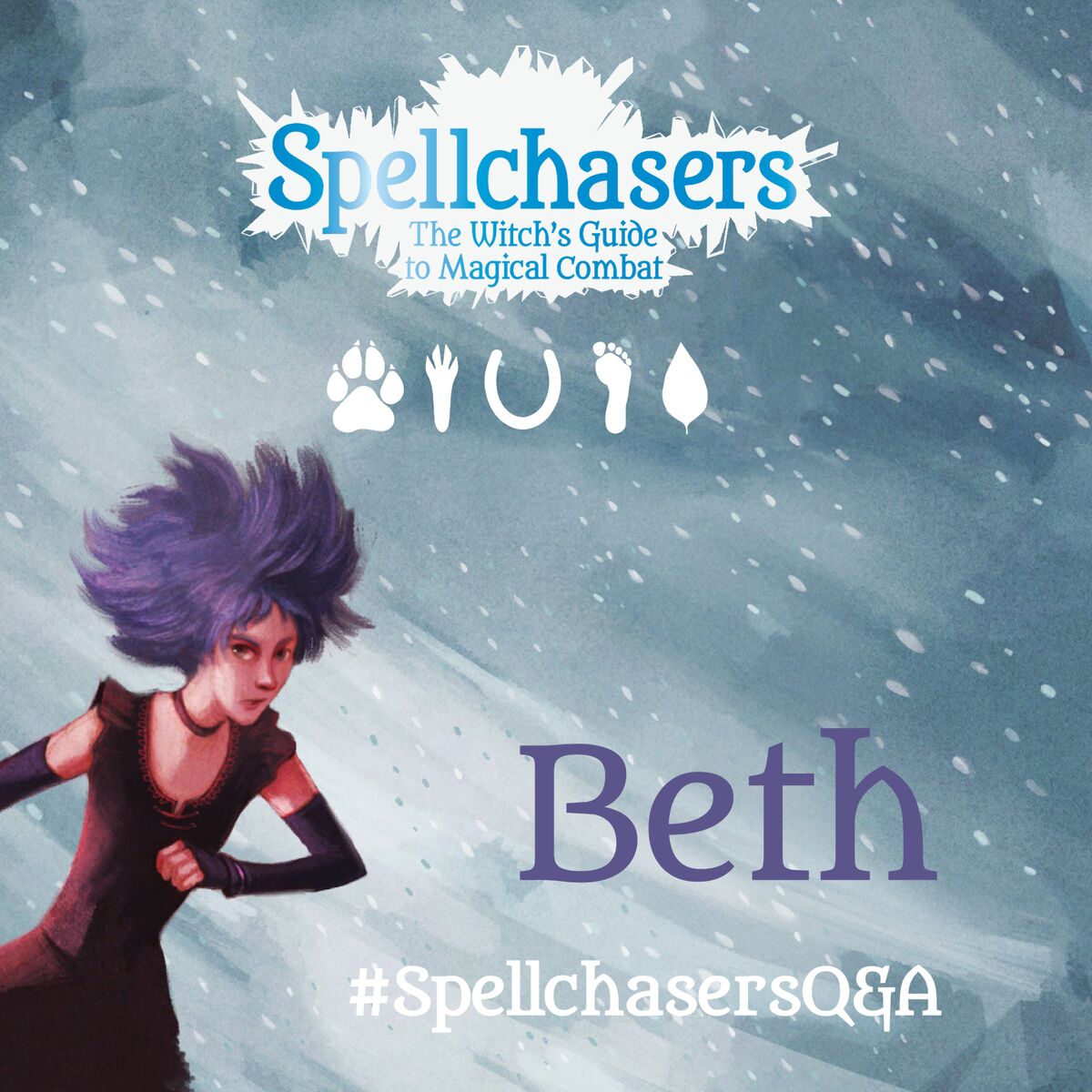
Beth
Q – Why are you so obsessed with dark magic, and with characters who use dark magic?
A – Probably because stories with a little bit of darkness are more exciting, to read and to write. And because you get so upset about dark magic, which is also fun to write…
Q – You feel sympathy for the witch who burnt my trees, don’t you? How dare you take her side rather than mine?
A – Yes I do. She was tortured and executed in a genuinely horrible way, and her curse on your trees was a panicked reaction to that. I don’t think she did the right thing, but I do feel sympathy for her and the circumstances under which she did it. The true history of how people accused of being witches (people who weren’t really magical at all) were treated in Scotland hundreds of years ago is really nasty and distressing, and I couldn’t write a trilogy about witches without recognising that. So, yes, I do feel sympathy for Meg Widdershins. But I’m not taking one side or the other, I’m trying to see both sides. Something which you very rarely do, Beth…
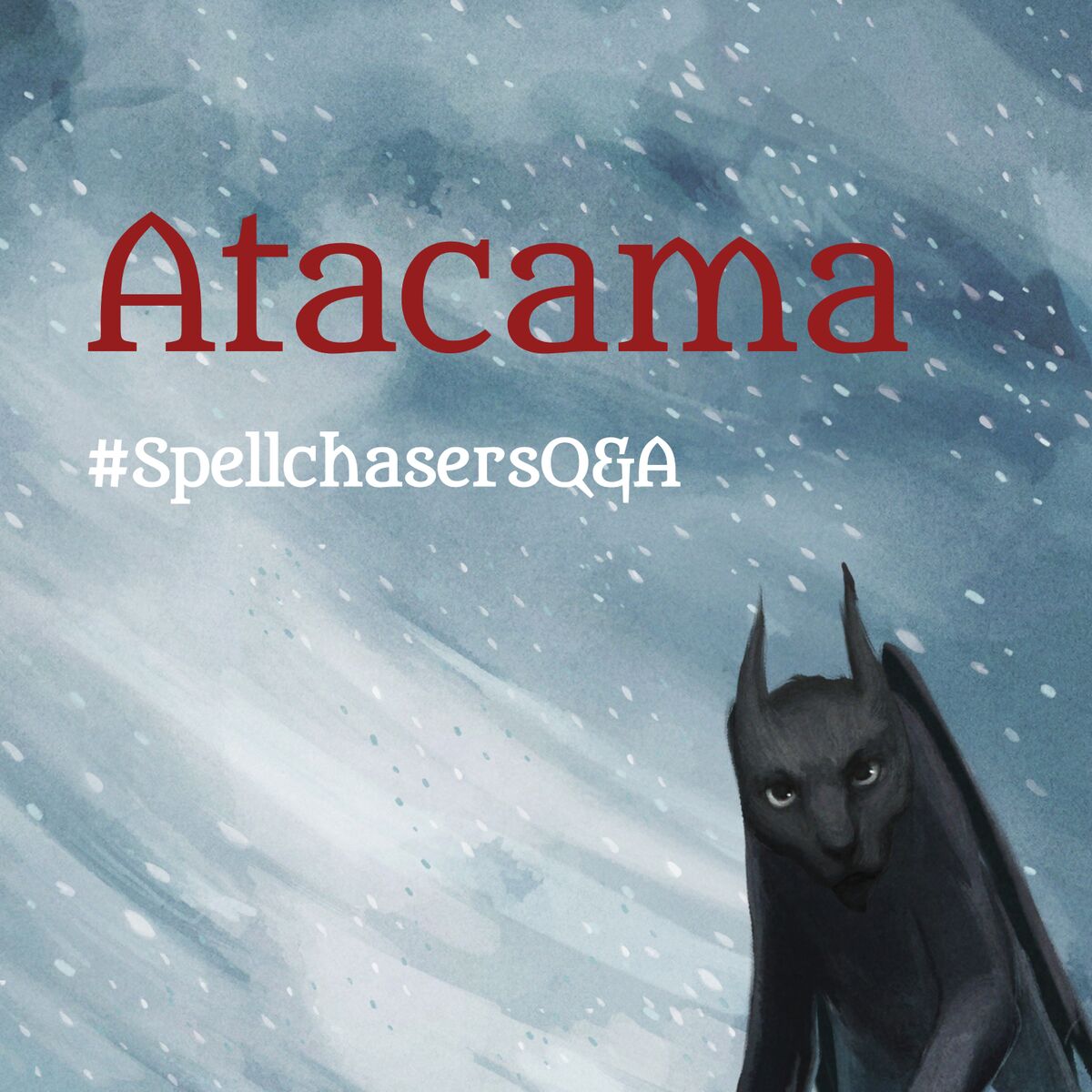
Atacama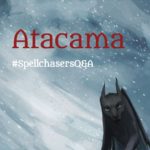
Q – Why do I have a job, when all my friends get to go to school and take holidays?
A – Oh, sorry! I wanted you to have a connection with riddles (because I love riddles!) and guarding a door to somewhere important, using a riddle as the password, made sense for your character and for the wider story. And I didn’t think you’d be guarding a door as a hobby, so I had to make it your job. Which I know meant you had to dash off to work quite a lot. Sorry. But I did give you a few catnaps as well. And as for not going to school – you have much more magical knowledge than either Innes or Beth, so you must be doing a lot of reading!
Q – And why do I work at a distillery?
A – Because I grew up in a house beside a distillery, and saw pyramids of casks every day when I was young. So when I needed somewhere that felt right for a sphinx in Speyside, I decided that you and your family would be guarding a door beside my own local pyramids…
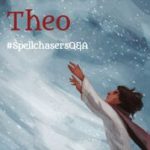
The toad / Theo
Q – Innes shifts into an elegant powerful horse; I transform into a clumsy warty toad. That doesn’t seem fair.
A – Kelpies have evolved to take on shapes that lure humans to the water, so their out-of-water forms have to be attractive. You were cursed to become a toad, so your form was meant to be insulting to you. Also, Innes has tentacles when he’s under the water, therefore he’s not elegant all the time!
Q – Why do you keep denying me the chance to use my full magical powers?
A – Partly because you have the potential to be so powerful that if you had your full powers right from the start you would probably defeat the baddies and shut the story down too fast. And partly because you are more interesting as a character and more fun to write when you are having problems. And honestly, I didn’t want to unleash your full powers until the battle at the very end.
Snib
Q – I joined the story really late, so am I a member of the Spellchasers team or not? I don’t get my symbol on the cover.
A – I think you have to decide that for yourself, and work out whether you can really be friends with people if you don’t tell them the truth about what you are doing…
Q – Why are you so cruel to your characters? You always take away the thing that means the most to them, like my wings.
A – Am I cruel? I suppose I am. I took your flight, Atacama’s riddle, and Theo’s power… But if I hadn’t taken something you really care about, you wouldn’t have a reason to go on dangerous adventures and face difficult obstacles to get it back. And I needed you to do that so I could write an exciting story. If I am cruel to my characters, if I take something you love and force you to take risks to get it back (and yes I realise that is horrible, sorry), then at least you know it’s all for the story and the readers…
A shorter version of this post was put up on the Discover Kelpies website during the Spellchasers blog tour in October, and some of the additional questions above came from our request for even trickier questions! I’d be happy to add more awkward questions if you want to suggest any! Possibly a few questions from the baddies?
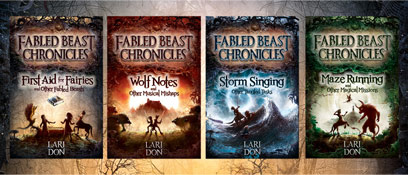
(And if you liked these awkward questions from the Spellchasers characters, you might enjoy this set of difficult questions from Helen, Yann and the other Fabled Beast characters)
|
| Dec 07 |
Filled under: Novels, Readers, Schools, Spellchasers trilogy, trilogy, Uncategorized | by laridon |
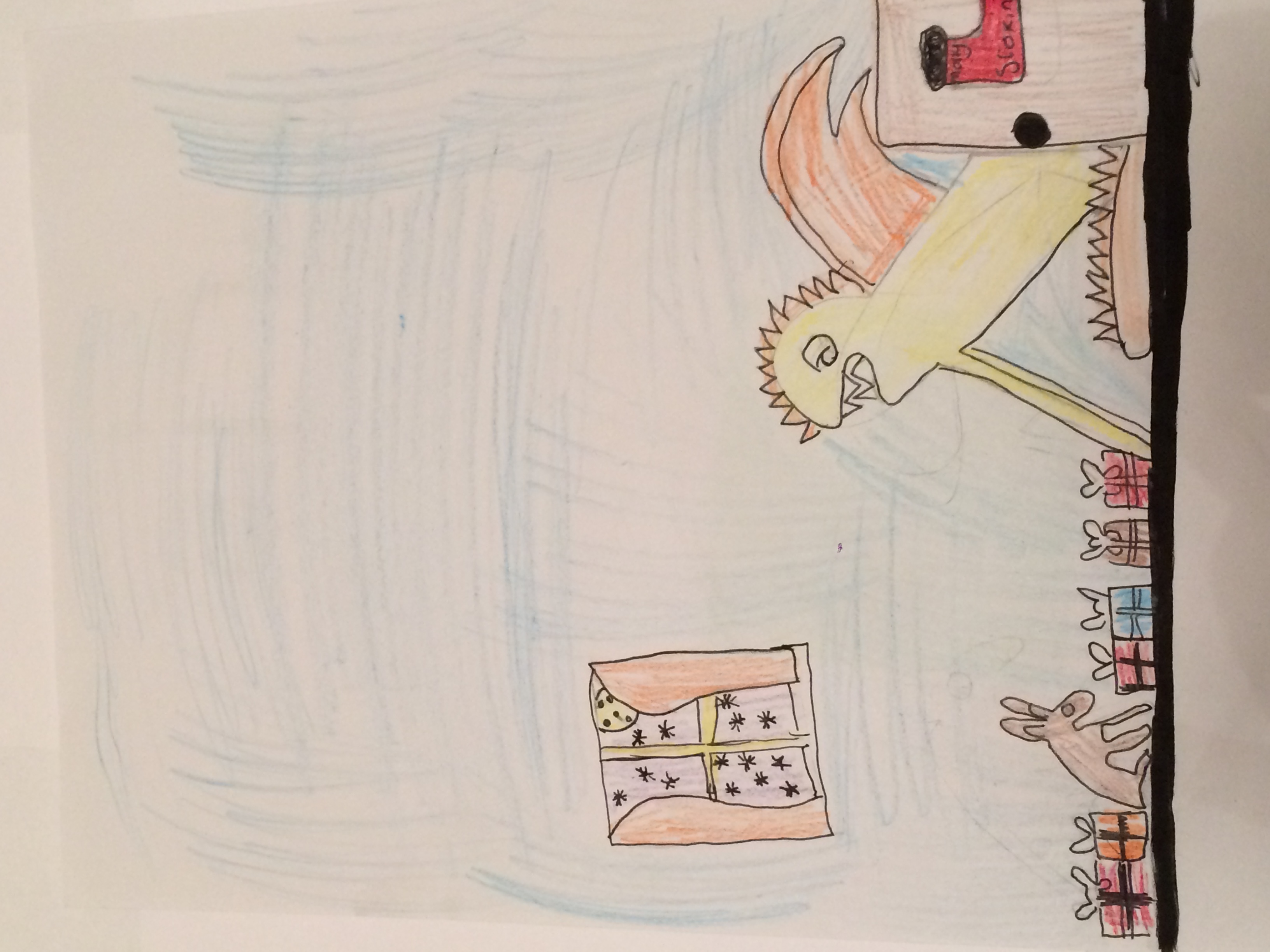
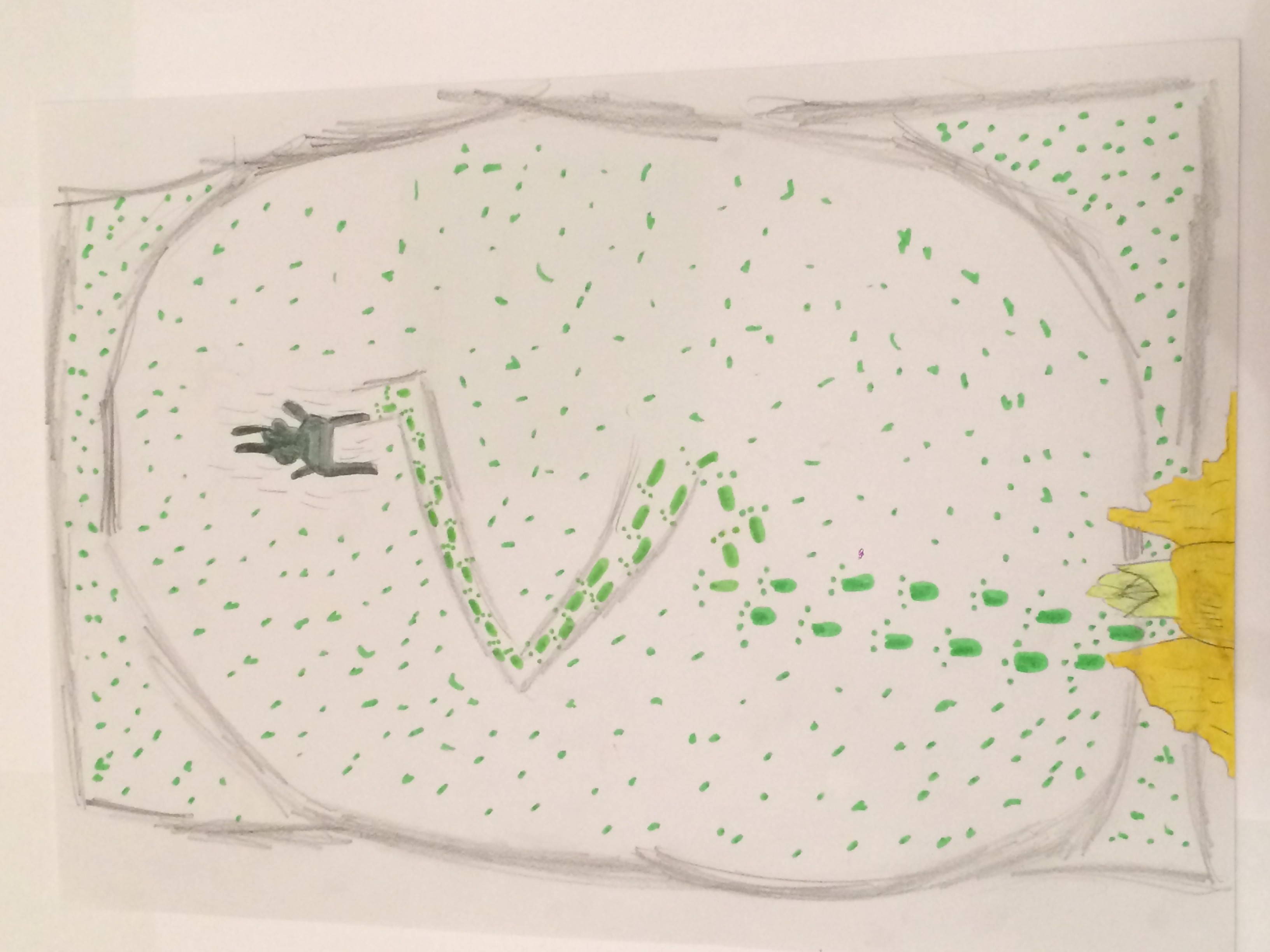
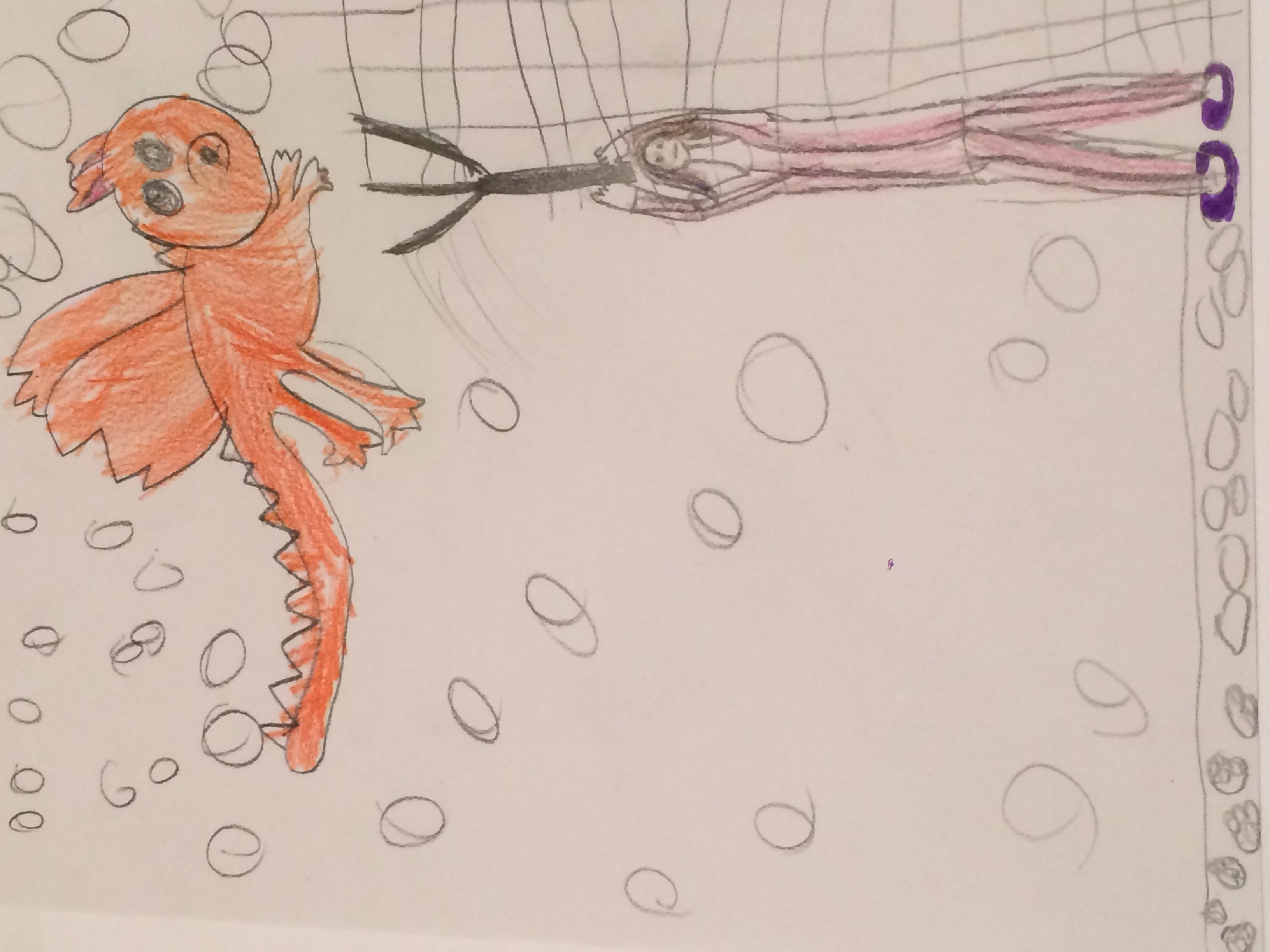
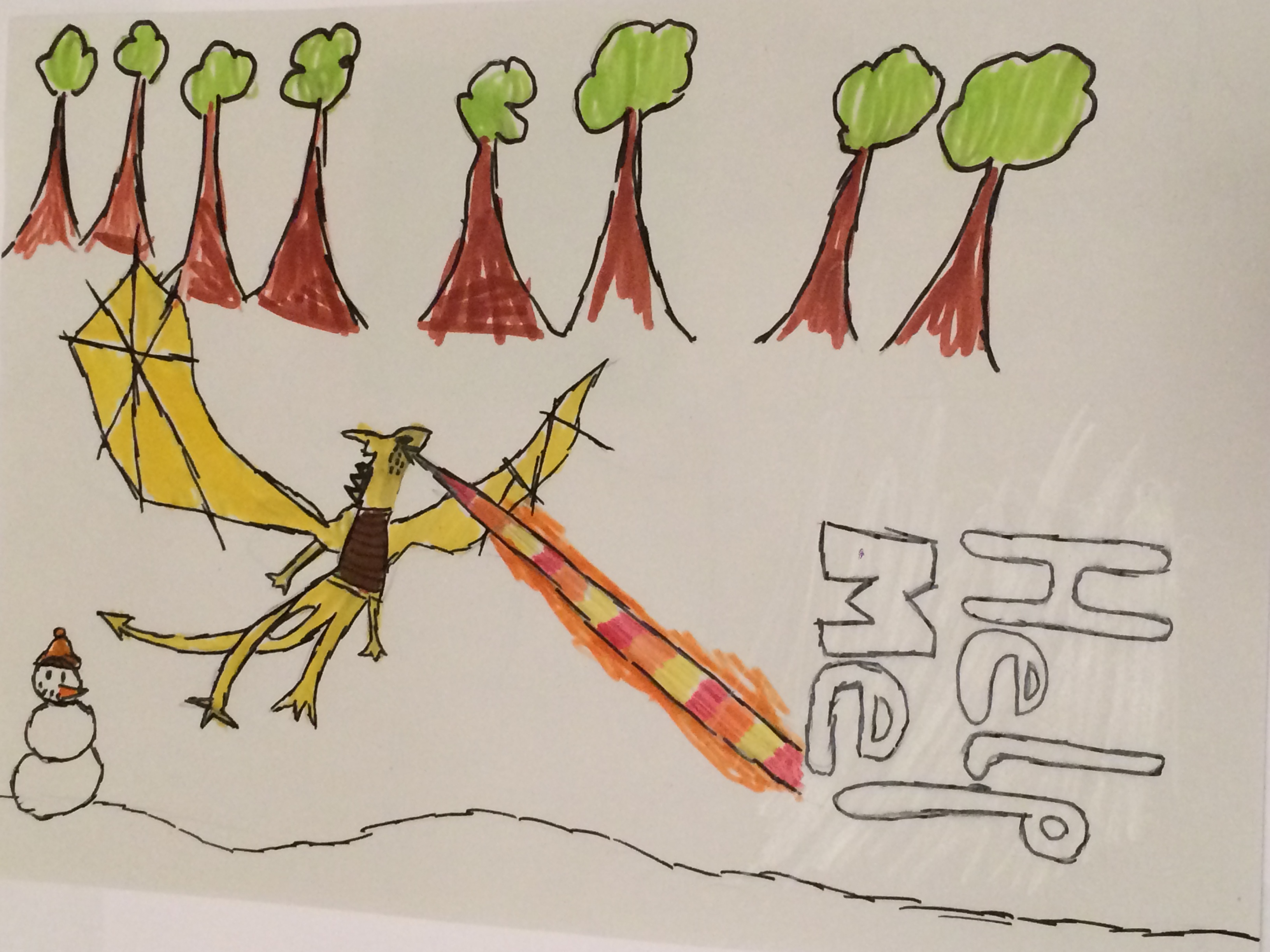
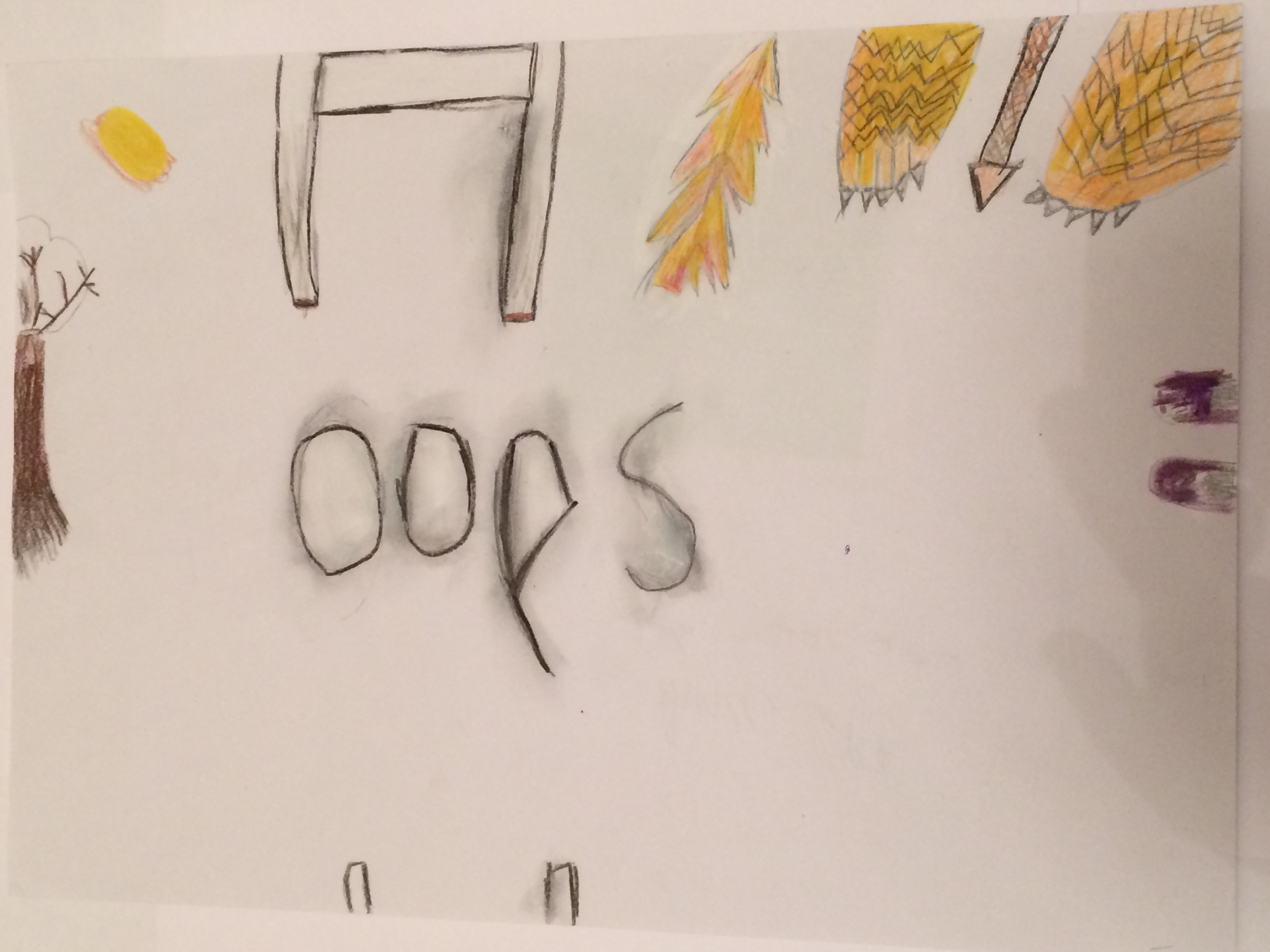
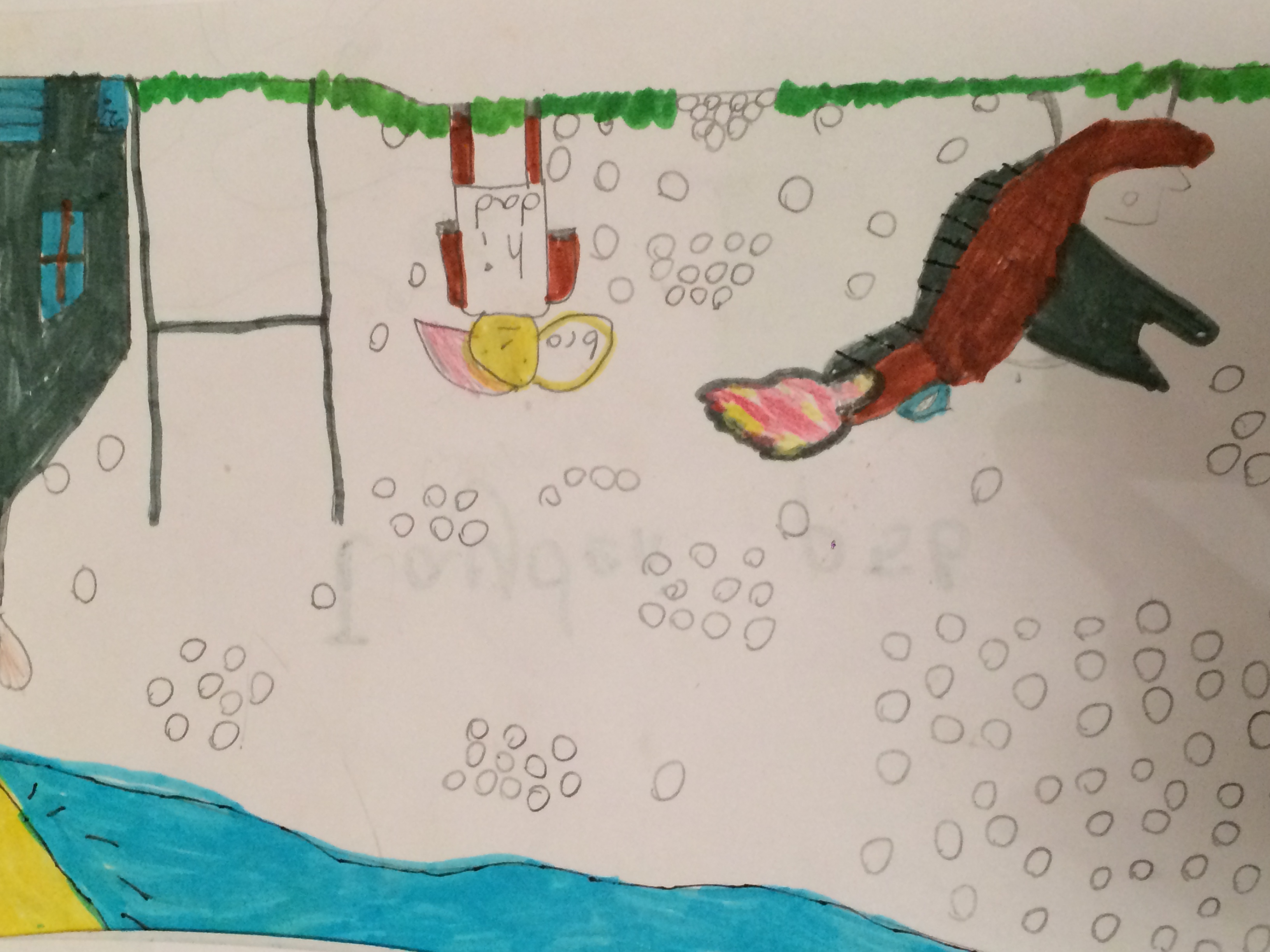
I’ve been working with the pupils at Pirniehall Primary in Edinburgh as their Writing Mentor this year, and they all created wonderful illustrations for this Christmas story about Molly. Here are the seven winning illustrations, which bring the story to life beautifully!
Pawprints in the Snow
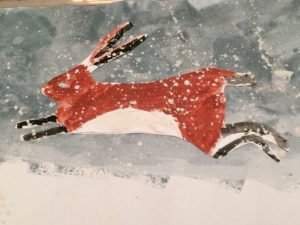 By David, P4 Molly’s paws made tiny dents on the crust of last night’s snow.
She had wished for a white Christmas, hoping to test her hare-speed on a new surface. But she hadn’t wished for the beast behind her. The creature she’d found chewing her stocking this morning.Now Molly could hear heavy breathing and heavier feet. It was catching up.
She felt hot breath on her neck; snow melted to water under her paws.
Molly leapt to the left, and her paws were back on cold crusty snow. She sprinted and zig-zagged across the rugby pitch, trying to escape the heat and the heaviness, the flames and the fangs.
The noise of the feet faltered, and stopped.
But Molly couldn’t stop running, because now she could hear flapping above her. Her wide hare vision showed that her pursuer had lumbered into the air and was swooping down towards her.
Speed wasn’t enough to beat this beast. Dodging and ducking wouldn’t work either, if it could hover above her.
How could she beat a predator that could run and fly and melt the snow under her?
Molly sprinted and leapt and sprinted again, hoping to confuse it, hoping to escape its long claws and hot breath.
She was used to magic and monsters in the wild lands of the north, but she hadn’t expected them to follow her south to the sensible streets of Edinburgh. She especially hadn’t expected to find a monster in her living room, chewing the end of her Christmas stocking.
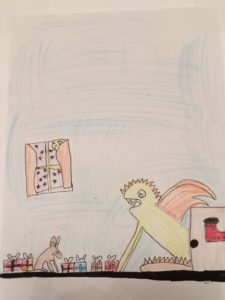 by Paris, P5a When she had walked into the living room, her first thought had been: don’t you dare eat my chocolate coins! Her second thought had been: I don’t want mum and dad to see this, and I don’t want this to see mum and dad. Her third thought had been: RUN! So she had flung open the back door and shifted into a hare in one practised move.
It wasn’t until she had been running down the back garden, drawing the beast away from both her chocolate coins and her parents, that she finally thought: what’s a dragon doing in my living room?
But now, Molly wished she’d found somewhere small to hide rather than somewhere wide to run. She circled and dodged and zigged and zagged across the school’s rugby field, and the dragon swooped and dived and soared above her.
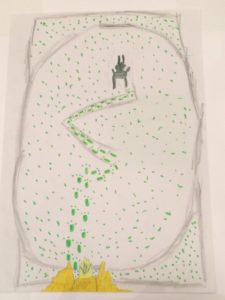 by Cooper, P6b Though, so far, it hadn’t tried to roast her or bite her.
Molly realised it wasn’t a very big dragon. It had seemed huge in the living room, but compared to the wyrm she’d met in Speyside in October, it was really quite small.
Perhaps she could fight it off.
Not as a hare. Hares can only run and punch. As a girl. Girls can wield weapons.
So she ran for the nearest fence, dived between the black iron railings, and became a girl again as she skidded along the icy ground.
That’s when she realised she was still wearing her pyjamas, and rabbit-printed cotton doesn’t give much protection against ice or snow. Or dragons.
She leapt to her feet, grabbed a long forked stick from the snowy ground and waved it at the pursuing dragon.
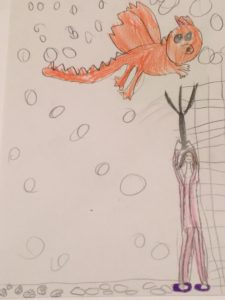 by Keira, P3 Who was no longer pursuing.
The golden dragon was perched on the tall spiked fence, back feet gripping the rail along the top, front feet tucked up almost like a squirrel’s paws. The metal fence was bending slightly under the dragon’s weight.
Molly shouted, “Go away!” and waved her stick.
The dragon was the size of a lion, or a tiger. Much bigger than a dog, slightly smaller than a horse. Definitely smaller than the wyrm Molly had chatted to in October.
So Molly waved her stick again. “Go away!”
The dragon’s shoulders sagged and its long spiky tail drooped.
Then the dragon fell clumsily backwards off the fence, landed on the rugby pitch, and blasted a long line of flame from its mouth. Molly backed off, planning to run the long way home, lock all the doors, and find the fire extinguisher from the kitchen.
But then she saw what the dragon was doing with the flame. The thin precise flame was melting shapes in the same snow Molly had marked with her zig zag line of pawprints. The dragon was writing words in the snow.
HELP, CURSE-BREAKER, HELP ME
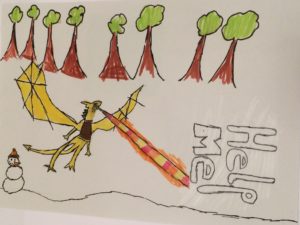 by Apisai, P6a Molly didn’t run away. She leant over the fence and asked, “You want me to help you?”
The dragon nodded, and perked up a bit, its golden tail wagging like a retriever’s. Then it swooped low along the edge of the rugby pitch, melting the snow with a long pen-like line of flame.
HELP ME BREAK MY CURSE. CURSED BY ANGRY WITCH – IF I BURN ANYTHING ELSE THIS YEAR, I WILL BURST INTO FLAMES MYSELF, TURN TO SMOKE & BLOW AWAY IN THE WIND
Molly walked beside the fence, reading the whole long sentence. She frowned. “Burn anything else? What did you burn the first time?”
The dragon drooped again. And wrote: WITCH’S GARDEN SHED. ACCIDENT. HICCUPS
Molly nodded. “So you annoyed a witch, and she cursed you so that if you burn anything else in the next week, you’ll become smoke yourself?”
The dragon nodded.
Molly shrugged. “So, just don’t burn anything…”
The dragon sighed, a little cloud of sparks. Then wrote: BUT I HICCUP AND COUGH AND SNEEZE AND SOMETIMES MY AIM ISN’T PREFECT. PERFECT. STILL LEARNING
Molly remembered the questions she’d been set as homework on the curse-lifting workshop. “Did you say sorry to the witch?”
The dragon nodded. SAID I HAD TO LEARN LESSON. AND CACKLED!
The dragon had written on all the snow near the fence. So Molly climbed the fence, and walked with the golden dragon to a smooth white part of the pitch. Molly’s slippers flapped soggily on her feet.
The dragon wrote in the clean clear snow. I’M SCARED. MAKE ONE MISTAKE AND I’M SMOKE.
“Do you burn things deliberately?” asked Molly.
The dragon shook its spiky sparkling head. NOT ANYONE ELSE’S THINGS. JUST MY TOAST AND MARSHMALLOWS. BUT … HICCUPS
“Is there any way to put your flames out and just not make any fire at all until the New Year?”
The dragon shrugged and opened its mouth. Molly saw a bright orange flame burning at the back of its throat.
The dragon hiccupped, a blast of flame jetted out of its throat, and Molly dropped to the ground, making a messy snow angel as she scrambled away.
The dragon wrote OOPS
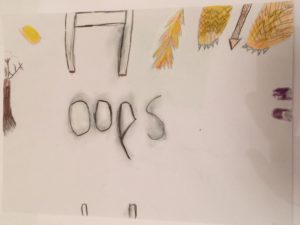 by Aimee, P7 “Just as well you didn’t burn me, or that would have ruined both our Christmases.” Molly stood up and brushed snow off her damp pyjamas, her fingers tingling in the cold.
She smiled. “I have an idea! Would you let me try to put your fire out? Just for a little while?”
The dragon nodded.
While the dragon danced around her, melting a spiral of clawed footprints into the snow, Molly made snowballs, her fingers growing numb as she formed the icy shapes. Once she had built a white pyramid of snowballs, she said, “Open your mouth, please.”
The golden dragon opened its jaws wide. Molly stood as close as she could bear to the furnace heat coming out of its mouth. And she started to throw snowballs in. Like one of those serving machines on a tennis court, she threw them in fast, one after the other, aiming for the back of the dragon’s throat, for the base of the orange flame.
She missed with one or two snowballs, some bouncing on the ground, one getting stuck in the dragon’s left nostril. But most of the snowballs hit the target.
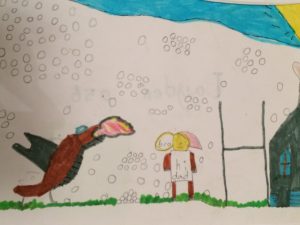 by Jayden, P5b The fire in the dragon’s throat fizzled and sizzled. Molly threw in even more snowballs. The fire became dimmer and dimmer, then died.
When Molly had used up all her snowballs, the dragon breathed out. And the air that hit Molly was warm, not flaming hot.
Molly nodded. “Now you can’t make fire, so you won’t trigger the witch’s curse. If you feel your throat sparking up again this week, eat more snow. And if you want, I’ll use you as snowball target practice again. So you can use the Scottish weather to get round the curse until Hogmanay.”
The dragon used its claws to scratch in the bare grass of the pitch, where Molly had scooped up snow to make snowballs.
THANK YOU CURSE-BREAKER. THANK YOU!
As the dragon flew away, Molly shouted, “But don’t eat yellow snow. And don’t eat any snowmen either!”
Molly squelched home, in her soggy slippers, to see if there were any chocolate coins left in her stocking…
THE END
By David, P4 Weren’t the illustrations amazing? Thanks so much to everyone at Pirniehall, pupils and staff, who created so much brilliant artwork – it was really tough choosing the winners from all your fabulous pictures…
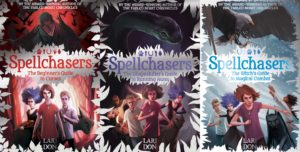
And if you want to read more about Molly’s adventures as a hare, you can find her at a curse-lifting workshop in the Spellchasers trilogy:
|
| Aug 14 |
Filled under: Book festivals, Bookshops, Events, New Novel, Spellchasers trilogy, trilogy | by laridon |
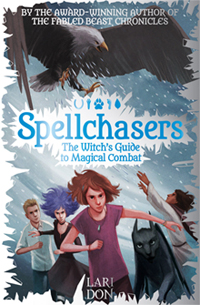
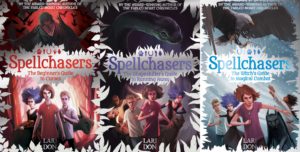
The Spellchasers trilogy now contains three books! (Maybe I’ve been misleading everyone by calling it a trilogy up til now, when there was only one book, then only two books?)
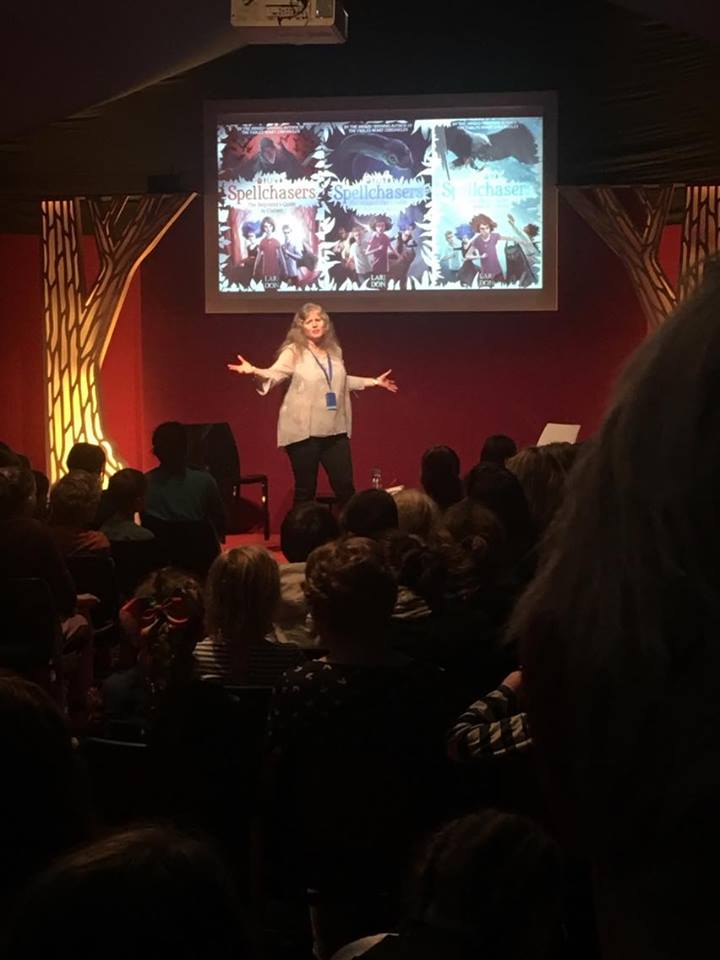
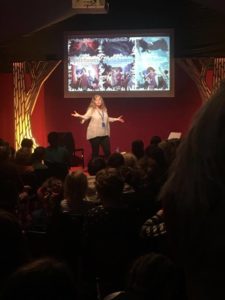 But now there are definitely three books, because I stood on stage at the Edinburgh International Book Festival on Saturday, to read from and chat about The Witch’s Guide to Magical Combat, the third book in the Spellchasers trilogy, then I signed quite a few shiny blue books in the signing tent afterwards. But now there are definitely three books, because I stood on stage at the Edinburgh International Book Festival on Saturday, to read from and chat about The Witch’s Guide to Magical Combat, the third book in the Spellchasers trilogy, then I signed quite a few shiny blue books in the signing tent afterwards.
So, the third book is out there. Young readers have started to read Molly’s last adventure. (And Beth, Innes, Atacama and the toad’s last adventure…) Which is incredibly exciting, for me anyway!
Does that mean The Witch’s Guide to Magical Combat has been published? No, not quite yet. This book has three birthdays. It was launched at the Edinburgh Book Festival at the weekend, so there are copies in the kids’ book tent in Charlotte Square right now. The official publication day is this Thursday (17th August) so it will be available in real bookshops with solid walls from the end of this week. And there will be a launch party, for my family and friends to nibble crisps while I talk about how I wrote the book, at the start of September. Then the book will definitely be out there and available!
 It was an amazing experience, holding all three books up, and talking about the whole story all at once. It felt like reaching the end of my journey with Molly and the rest of the Spellchasers team. It was an amazing experience, holding all three books up, and talking about the whole story all at once. It felt like reaching the end of my journey with Molly and the rest of the Spellchasers team.
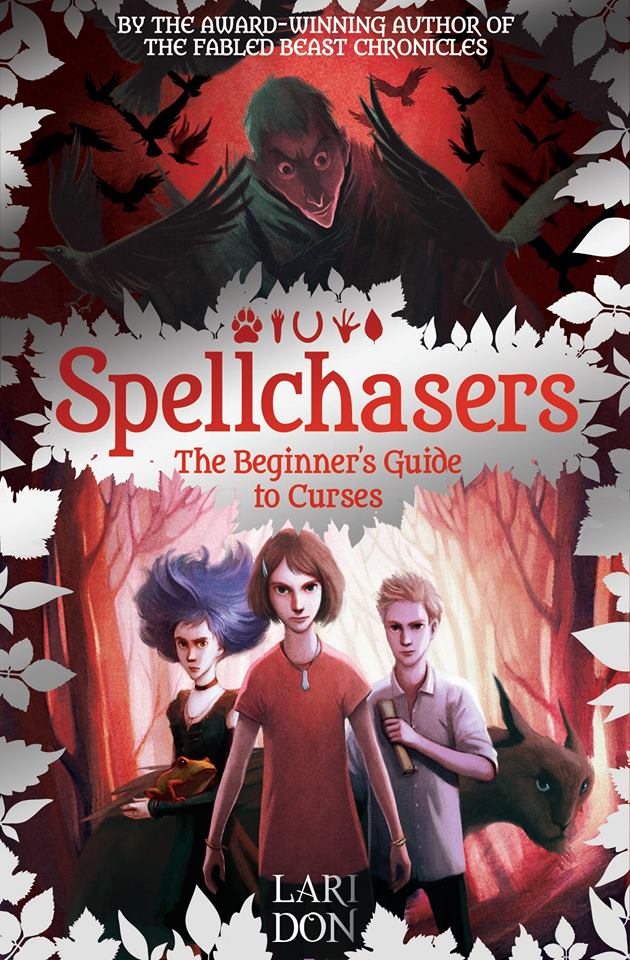
It wasn’t easy though. I’ve realised that discussing a trilogy without giving away spoilers is very tricky. Some of the questions asked by audience members who’d read The Beginners’ Guide to Curses and The Shapeshifter’s Guide to Running Away were very specific, so I tied myself in knots not to give too much away to people who hadn’t read that far yet. The one about the toad’s back story and the one about Molly’s changing relationship with her curse were particularly hard to answer honestly without ruining the story!
But despite having to dance round spoilers, I had fun! It was wonderful to share a tent with so many adventure fans, and with all their imaginative ideas and knowledgeable questions. 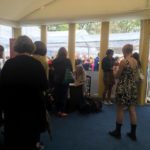
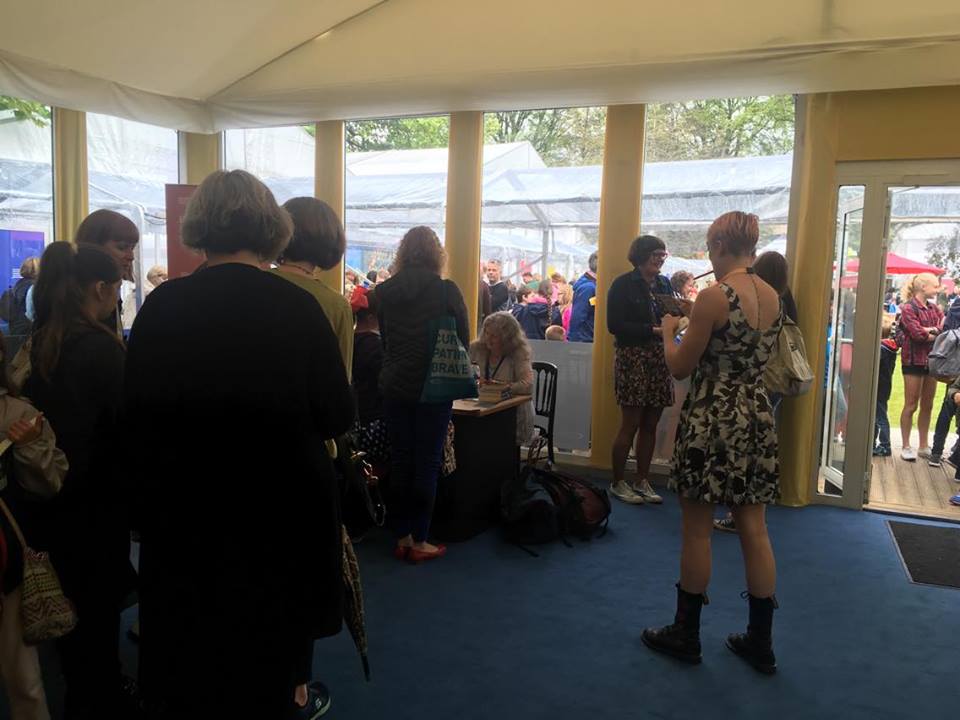
The signing queue was great too. It was quite long, but everyone was very patient and cheerful. I dedicated lots of books to keen Atacama and Beth fans, so clearly writing about big black cats with riddles and trees with attitude was a good plan! I also spoke to lots of kids who are already writing their own stories, so perhaps I’ll be enjoying their events at the Edinburgh Book Festival in a few years’ time…
So, now that the trilogy is complete, it’s time I made a tough decision. What story will I write next?
|
| Jun 19 |
Filled under: Events, Fabled Beast Chronicles, Heroines and heroes, New Novel, Novels, Readers, Spellchasers trilogy, trilogy, Writing | by laridon |
The final book in the Spellchasers trilogy has now gone to the printers. I can’t make changes to it, ever again. I can’t change the little things, like commas, and I can’t change the big things, like who wins the battle at the end. The book is finished. It’s not mine any more, it’s very nearly yours instead.
(The Witch’s Guide to Magical Combat is published in mid-August, and if you want to hear me chat about it before it’s even in the shops, come and see me on the first day of the Edinburgh Book Festival. And if you want a really early copy, check out this competition.)
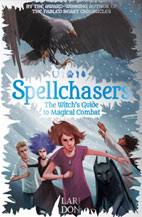
So, how do I feel right now? Now that I’ve said goodbye to Molly, Innes, Beth, Atacama, Theo, Corbie, Mrs Sharpe, Estelle and Snib…
I feel sad. This trilogy has contained lots of my favourite characters, and lots of my favourite magic, chases, and fights. I might never write about Molly, her friends and her enemies again. I’ll read the books out loud at author events, but I won’t be able to change the outcome, or tweak the dialogue, or suddenly change my mind about a moment of magic. So, saying goodbye after years of writing this trilogy is sad.
But I also feel relieved. Writing a trilogy has been a huge challenge, much harder than anything I’ve ever written before. and I got to the end! And I think it worked! (Though honestly, I won’t know if it really has worked until I hear from readers…)
And I’m exhausted. Writing three novels containing four stories (one story per book, and one story arching over the whole trilogy) has been extremely tiring. I’ve had to hold the whole story – more than 150,000 words – in my head at once, which hasn’t left much space for anything else! And publishing the books at six monthly intervals has been an interesting and energy-sapping experience…
But I’m also excited! I’m excited because I want to know what you think about how I decided (or how Molly decided) to end the story. I want to know what you think about the new characters I introduce in Witch’s Guide. I want to know what you think of the biggest battle I’ve even written. (Actually, maybe I’m nervous about all of that, rather than excited…)
But there’s something else I am genuinely excited about:
What’s next?
This trilogy has been the main story in my idea for years. For YEARS. And now it’s finished. So, what will I write next?
That’s not an easy question to answer. I’ve spent more than 4 years writing and editing the trilogy. I’ve never spent less than a year on a novel. So whatever I decide to write next will be a huge chunk out of my life. And whatever story I decide to write next, that decision will mean not writing lots of other ideas. So it’s a very hard decision to make.
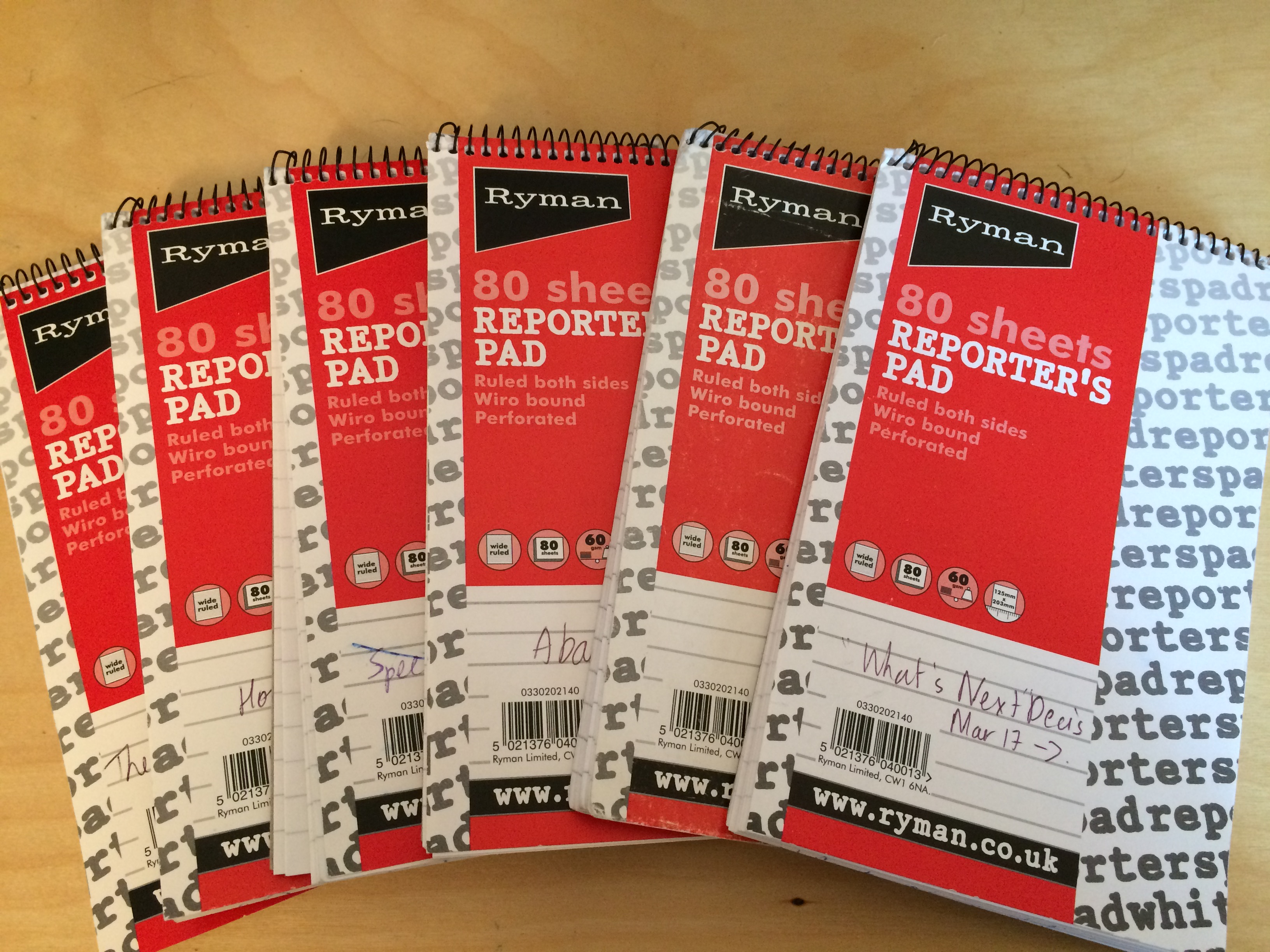
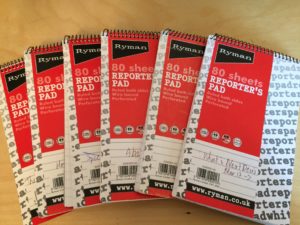 not an ad for a stationery shop – all the notebooks I’m scribbling ideas in right now I have lots of ideas for novels. Some of those ideas arrived in my head years ago, and have been waiting patiently for me to finish the Spellchasers trilogy. At least one idea arrived while I was editing Spellchasers (just like the idea of a curse-lifting workshop rose out of a subplot in the Fabled Beast Chronicles). And I’m planning to allow myself a few months free of deadlines, in order to simply read and think and play with ideas, so perhaps the perfect idea hasn’t yet arrived in my head.
There are lots of things I love about writing (and this bit – finishing a story, and passing it on to readers – is one of the best bits.) But my favourite thing of all is the process of an idea coming to life: a story starting to grow and develop and spark and bounce and fill my head. The first few pages of a new book, the first few lines in a new character’s voice. The first time I see the journey ahead, the paths that this new story could take me down. I love finishing books, but I love starting new ones even more.
So ‘what’s next?’ is never an easy question. But it is the most exciting one.
Ultimately, I always end up writing the story that demands to be written, about the characters who just won’t leave me alone. So, I think I’m going to sit quietly now, and listen, and find out what story is shouting the most interesting questions in the loudest and most intriguing voices…
In the meantime, if you want a chance to read Witch’s Guide before anyone else, here’s a competition to win an early copy.
|
| Jun 07 |
Filled under: Monsters (defeating!), Novels, Picture Books, Readers, Spellchasers trilogy, trilogy, Writing | by laridon |
When I chat to readers about the books I write, I often mention the joy of working with wonderful artists like Cate James and Philip Longson, and the privilege of seeing the stories I’ve written come to life in their illustrations.
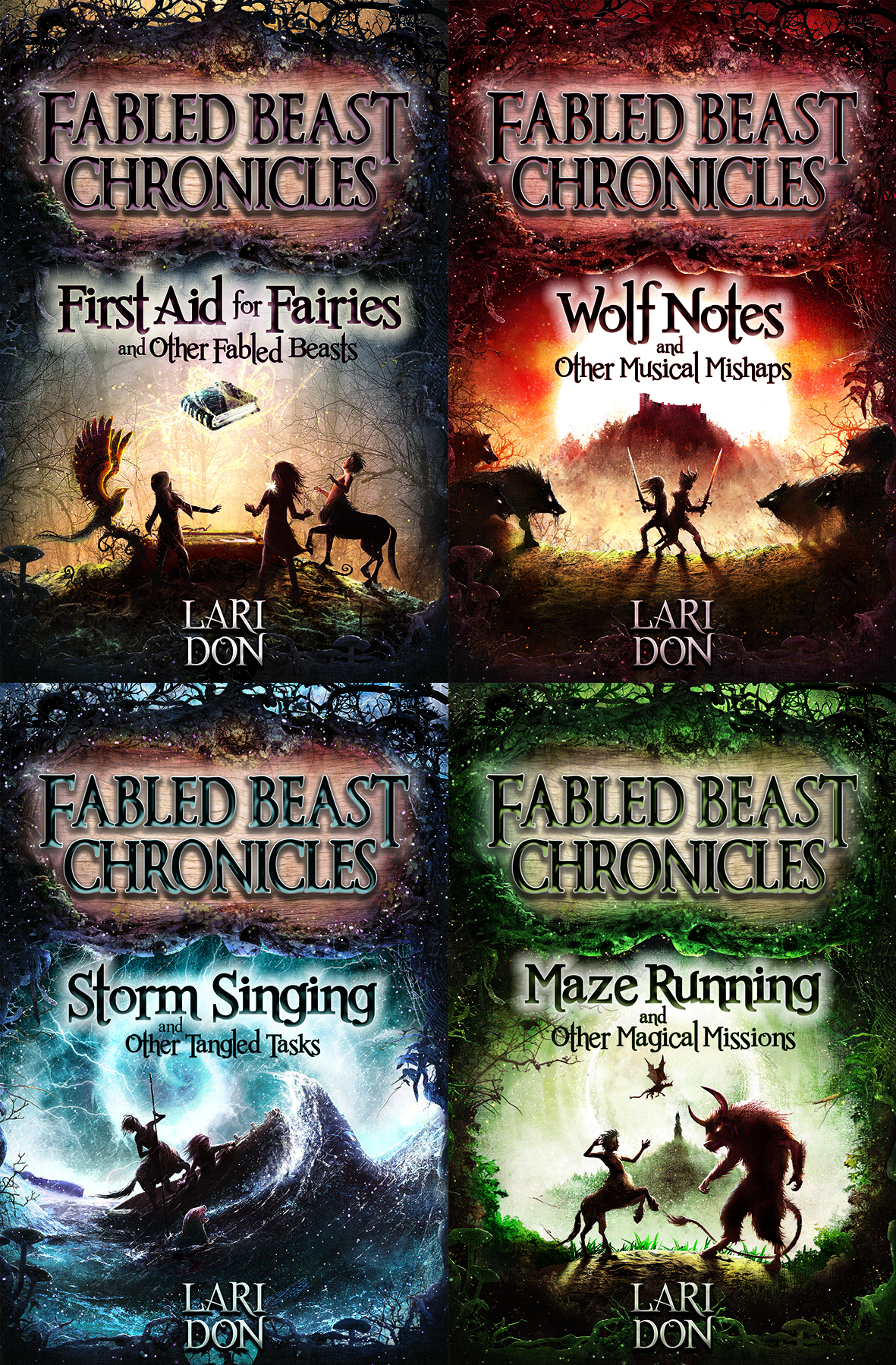
But then I admit that the pictures I love most are the pictures I never see. The pictures inspired by the novels I write. The pictures that you, the readers, create in your own heads as you read the Spellchasers trilogy or the Fabled Beast Chronicles or Mind Blind or Rocking Horse War…
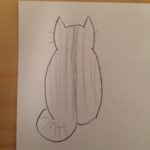
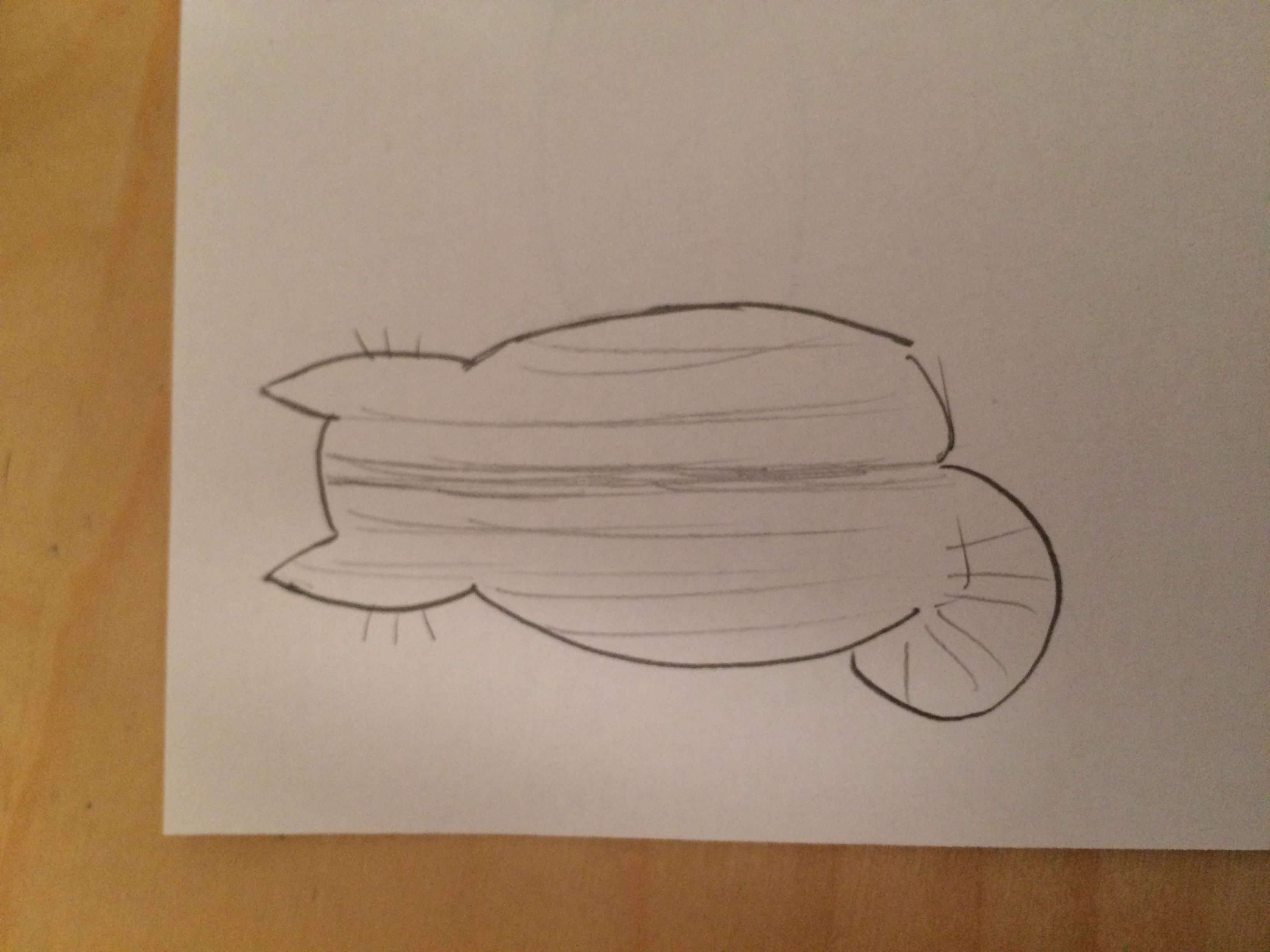
I can’t draw. Not at all. If I draw a cat, I draw it from the back, so I don’t have to attempt the face or the paws. (I can just about do ears…) So when I write a novel, I draw with words. I hope to draw pictures in your heads: a collaboration between my words, and your imaginations.
I’d love to see those pictures on paper, I’d love to discover what you see when you read about Molly shapeshifting or Innes galloping or Beth with her trees or Atacama by his pyramid.
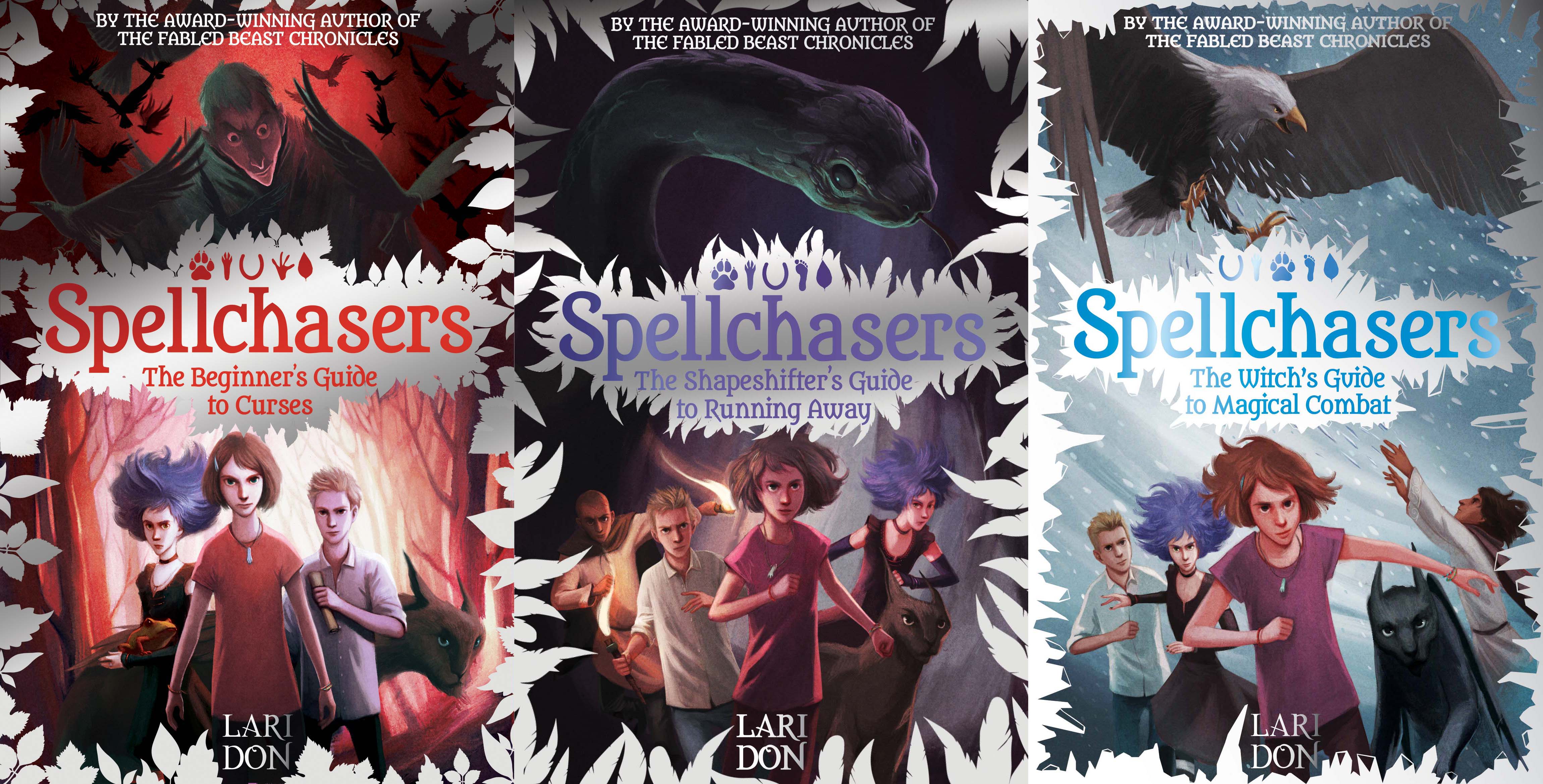
And now I’ll get the chance to see those pictures! Because my publishers Floris are running a Spellchasers competition, with a prize of the full Spellchasers trilogy (including a very early copy of the final book, The Witch’s Guide to Magical Combat) for the best picture of a character or a scene from the two Spellchasers novels so far. The winner will also get a print of their artwork (which is a splendid prize!) and all the shortlisted artists will get one of those early copies of The Witch’s Guide.
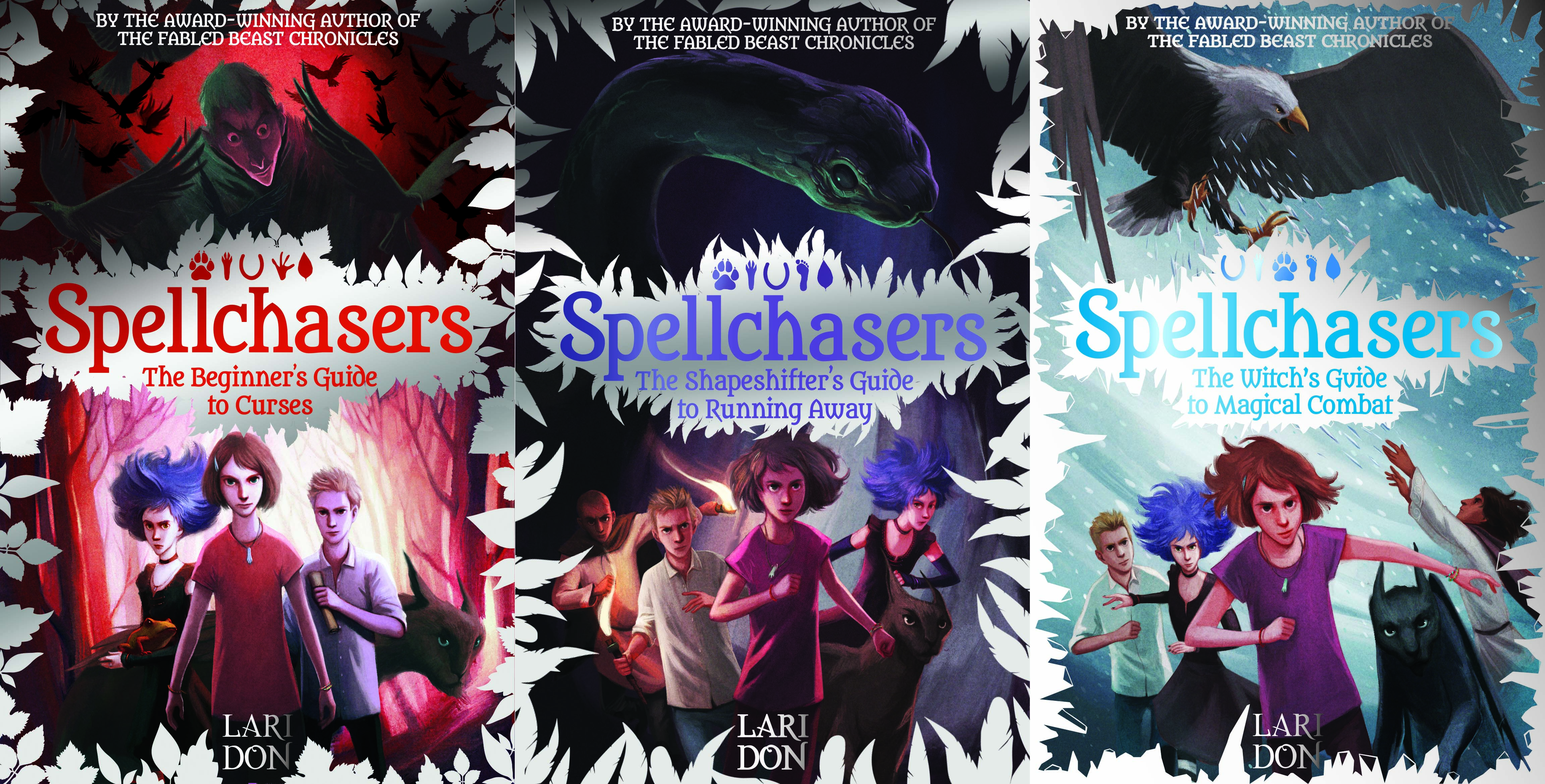
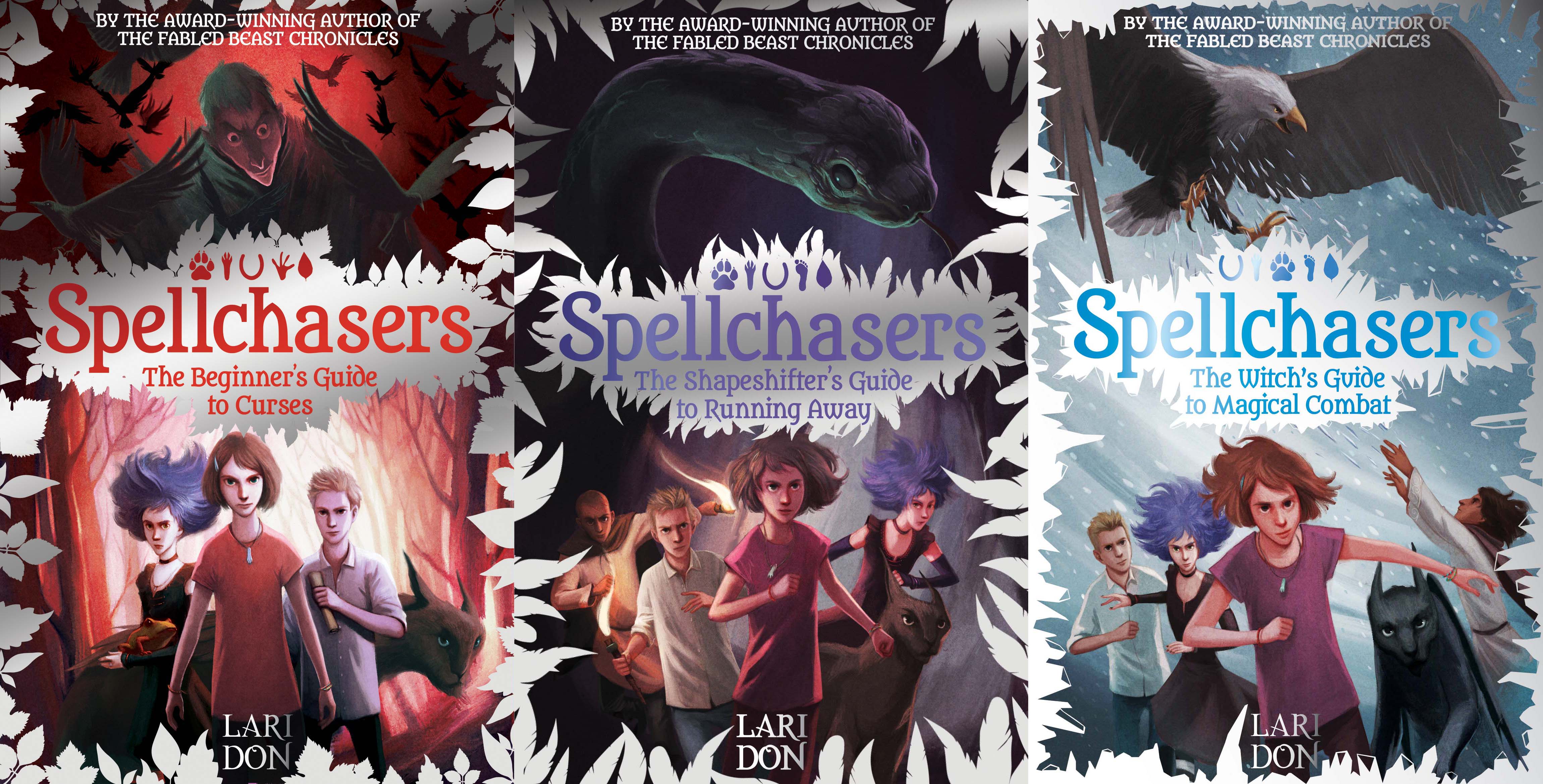
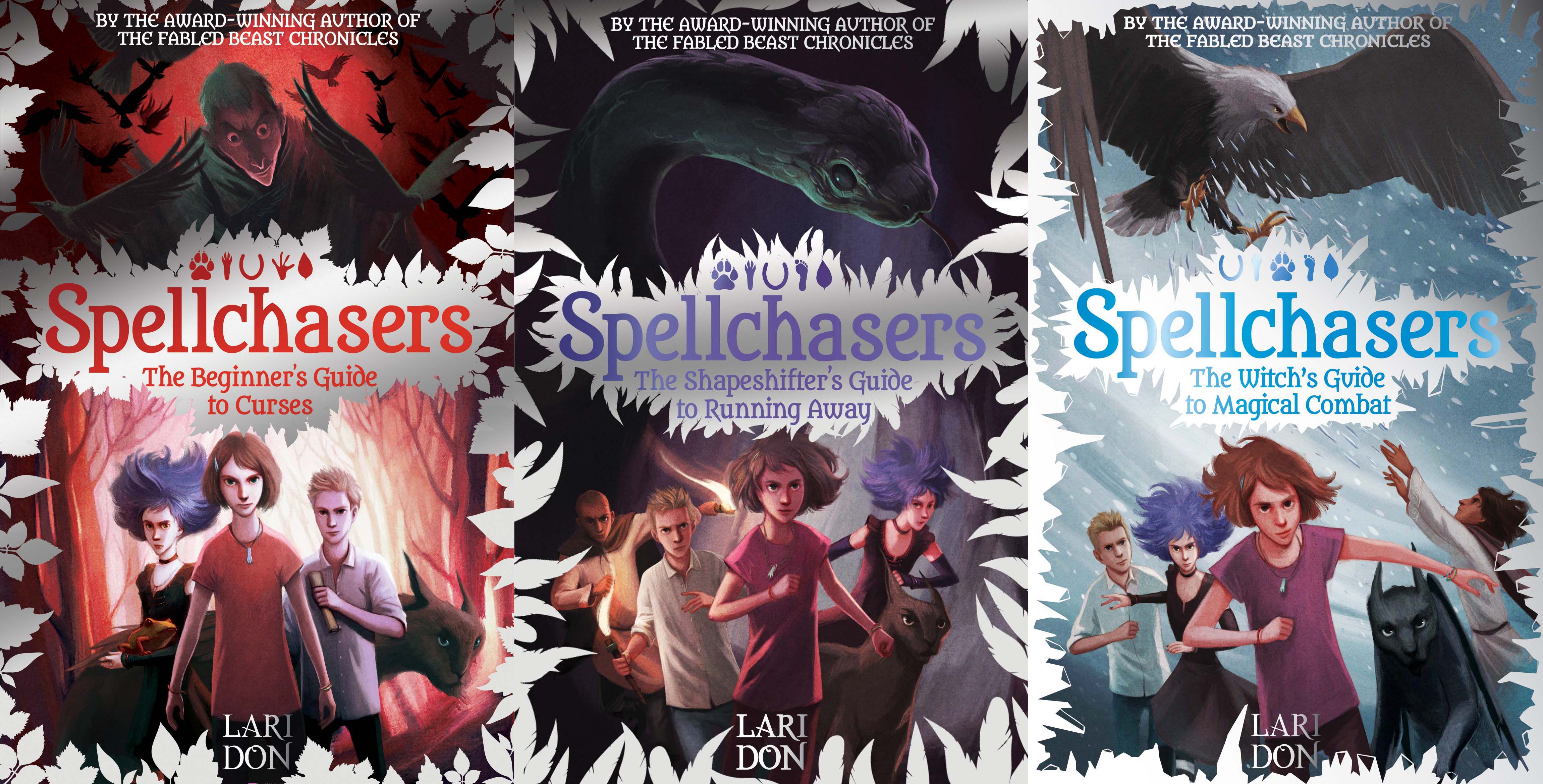
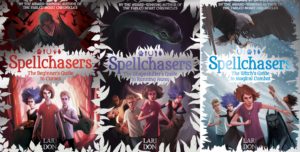 Jordi Solano has created wonderful covers for the Spellchasers trilogy, but you might imagine the characters differently, and you will have your own images of the monsters and magic and action that aren’t on the covers. Jordi Solano has created wonderful covers for the Spellchasers trilogy, but you might imagine the characters differently, and you will have your own images of the monsters and magic and action that aren’t on the covers.
So, what will you draw?
Will you draw the dryad, the kelpie, the sphinx, the toad? Or Molly herself? (As a girl? Or a hare? Or shapeshifting between the two?)
Will you draw a baddie? A flock of mobbing crows, a hunting pack of nuckelavee, a circle of grey men, a line of mosaic warriors, or a warrior queen by a roaring fire?
Will you draw one of the magical locations? The Promise Keeper’s Hall, the witch’s farm, a Speyside pyramid, a cave, or Beth’s wood?
Whatever you draw, I’ll be fascinated to see what adventures the Spellchasers characters have in your heads and in your pictures, once they’ve left my keyboard! I’m really keen to find out what you see when you read!
All the details of the competition are here: http://discoverkelpies.co.uk/2017/05/spellchasers-fan-art-competition/
And the closing date is the 23rd of June.
Best of luck!
|
| Mar 16 |
Filled under: Fabled Beast Chronicles, Maze Running, Mind Blind, New Novel, Novels, Spellchasers trilogy, trilogy, Uncategorized, Writing | by laridon |
‘Where do you get your ideas from?’ I’m asked that question at almost every author event. It’s a great question, but there’s no quick easy answer!
My ideas don’t come from a place. I don’t think it’s possible to draw a map of where ideas come from. Maybe we need a history of ideas, rather a geography of ideas? Because I can tell you the history of the Spellchasers idea coming to life in my head…
All stories start with a spark of an idea, usually a ‘what if…?’
But Molly’s story started with three different sparks, at three different times. Which is probably appropriate for a trilogy!
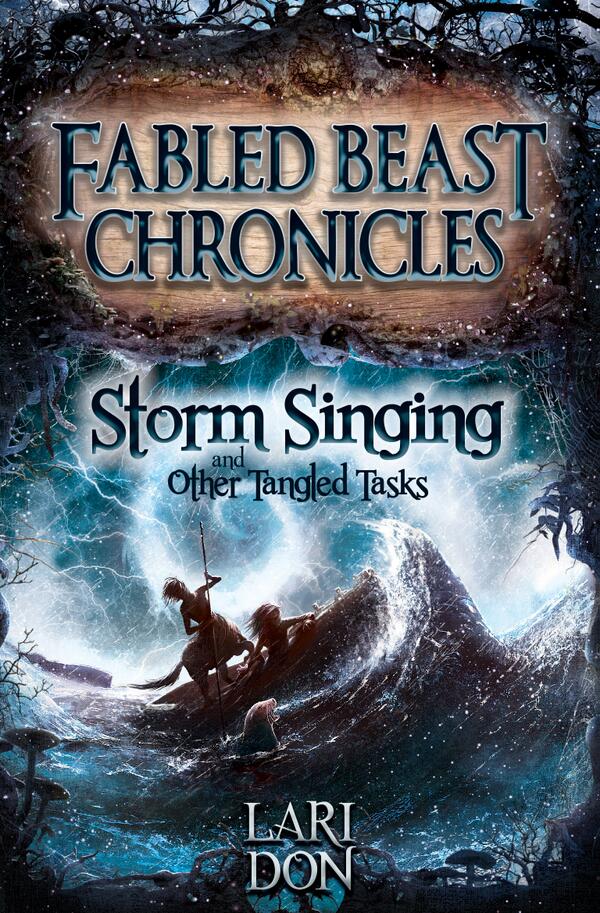
The first spark arrived when I was writing the third novel in the Fabled Beast Chronicles. That must have been in 2010 or 2011 – 6 or even 7 years ago. One of the new characters in Storm Singing was a mermaid called Serena. I had lots of fun writing her, partly because I was never entirely sure whether I liked her or not. And Serena was cursed. She was taking part in the same Sea Herald contest as my main character Rona, because she thought winning would help her to lift the curse on all mermaids. And one little line of Serena’s dialogue made me think about whether there was a right and wrong way to lift a curse, ie whether there were rules of curse-lifting, and I wondered if there was a story in that.
But I was still in the middle of editing Storm Singing and I knew there was another Fabled Beast Chronicles book to come, so I just scribbled the thought down and put it to one side.
So that was a wee spark, about the rules of curse-lifting. And it sat in my head for a while.
Then there was the moment that the story arrived. That wasn’t a spark, that was a firework, exploding in my head. I still remember how it felt.
It was in January, 2012, so just over 5 years ago. I was meant to be doing my tax return, but that’s really boring, so instead, I was having fun typing up a list of possible future book ideas.  I found the little note I’d made about Serena’s curse, and I started to add it to the list, but as I typed, the sentence about rules of lifting curses became a question about ‘what if…?’ ‘What if there was a workshop about lifting curses, and what if lots of young cursed fabled beasts met on that workshop… ?’ And suddenly I wasn’t typing a list of possible future books, I was typing characters and curses. Then I started to see and hear what I thought might be the first scene, in a room with desks, and they were all snarking at each other and arguing about curses… I found the little note I’d made about Serena’s curse, and I started to add it to the list, but as I typed, the sentence about rules of lifting curses became a question about ‘what if…?’ ‘What if there was a workshop about lifting curses, and what if lots of young cursed fabled beasts met on that workshop… ?’ And suddenly I wasn’t typing a list of possible future books, I was typing characters and curses. Then I started to see and hear what I thought might be the first scene, in a room with desks, and they were all snarking at each other and arguing about curses…
This is a blog post I wrote that day, showing just how excited I was… Rereading the post now is quite odd – I can still remember that physical sense of a story coming to life in my whole body, not just my head. (Also notice how I carefully didn’t give anything away about the details of the idea!)
So that was the point when I knew that this idea was strong enough to be a book.
But I was still finishing the Fabled Beast series and I knew I wanted to write Mind Blind next. So I put this idea to the side again. But I was really excited about it, and I was sure it was one I was going to write very very soon. However, at that point, the idea was based around a mermaid, not a hare. So it still wasn’t Molly’s story.
And then, the third spark:
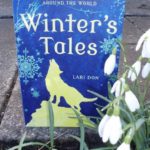
In 2013, so almost 4 years ago, someone asked me to write a very short story about winter, to publicise a book of winter stories I was launching. The first image that came to mind for a winter tale was a hare’s pawprints in the snow. So I wrote a page about running like a hare, about being chased as a hare. And as I wrote, I knew this wasn’t a real hare, it was a person who had become a hare.That was when I knew who my main character was, and what her curse was. And I knew this book was no longer about a mermaid, which I’d honestly never been convinced about, it was about a human girl transformed into a hare.
That was also when I knew that I had to write this book as soon as I could. In fact, I never sent the winter hare story (I wrote something else about paper snow) because I knew this character’s adventure wasn’t a short story, it was a novel.
But soon, it wasn’t even a novel, because once I went on the curse-lifting workshop with Molly and the others, there was so much story, so much magic, so many questions to answer, that it become a trilogy.
And now you can read the trilogy (well, the first two parts anyway!)
So that, as far as I can remember it, is the history of how the idea for the Spellchasers trilogy arrived in my head and grew into the story I started to write. But it’s still not a complete answer to the ‘where do you get your ideas from?’ question, because every other novel idea has arrived in a completely different way!
Though one common factor is noticing the ideas when they arrive, and remembering to write them down. And the other common factor seems to be that writing stories (or even lists) gives me ideas for other stories! So that’s not a ‘where’, that’s a ‘when’ and a ‘how’ and maybe even a ‘why’…
|
| Feb 27 |
Filled under: Events, Fabled Beast Chronicles, Myths, legends, folklore, Readers, Schools, Spellchasers trilogy, trilogy, Uncategorized | by laridon |
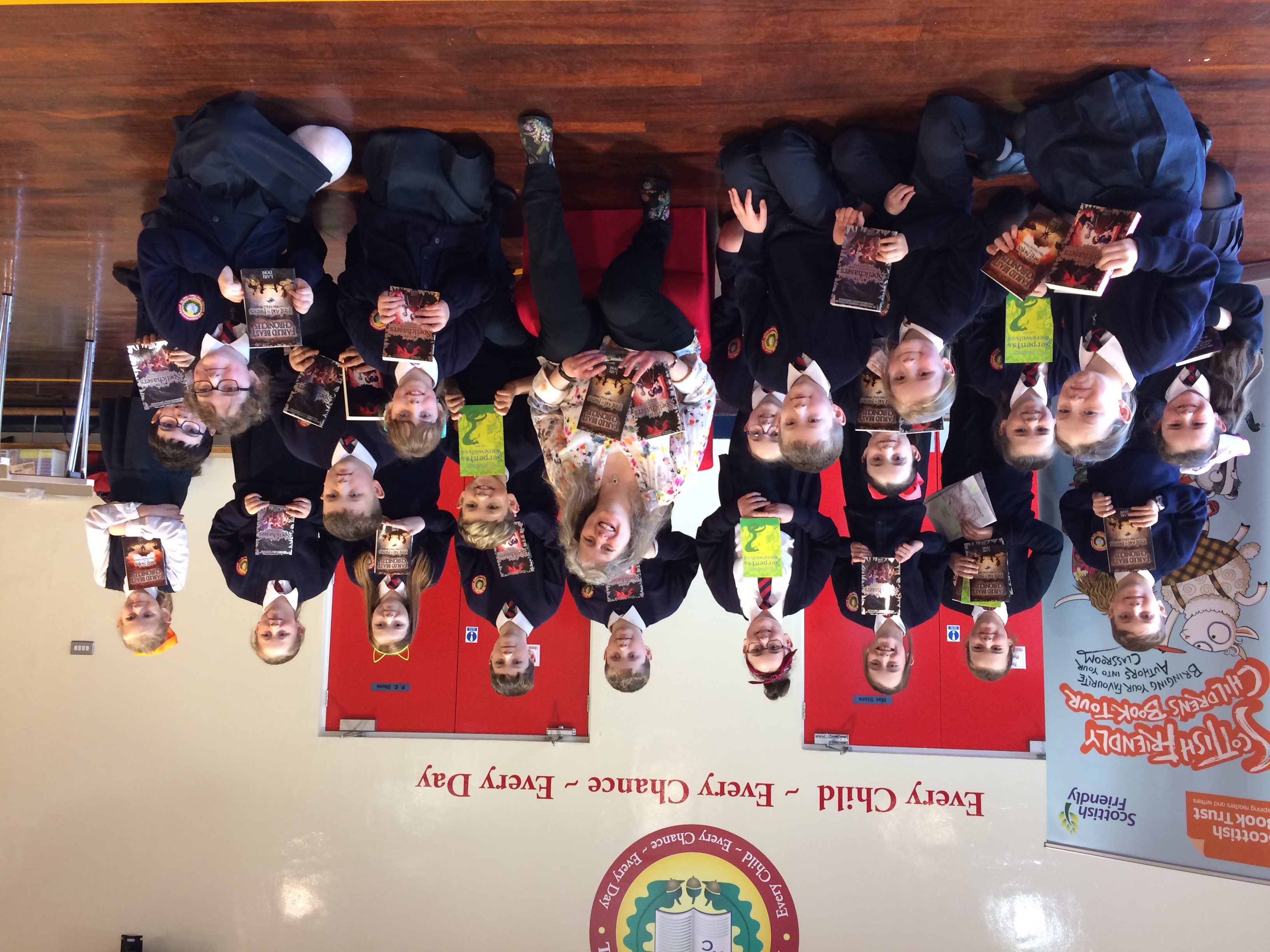
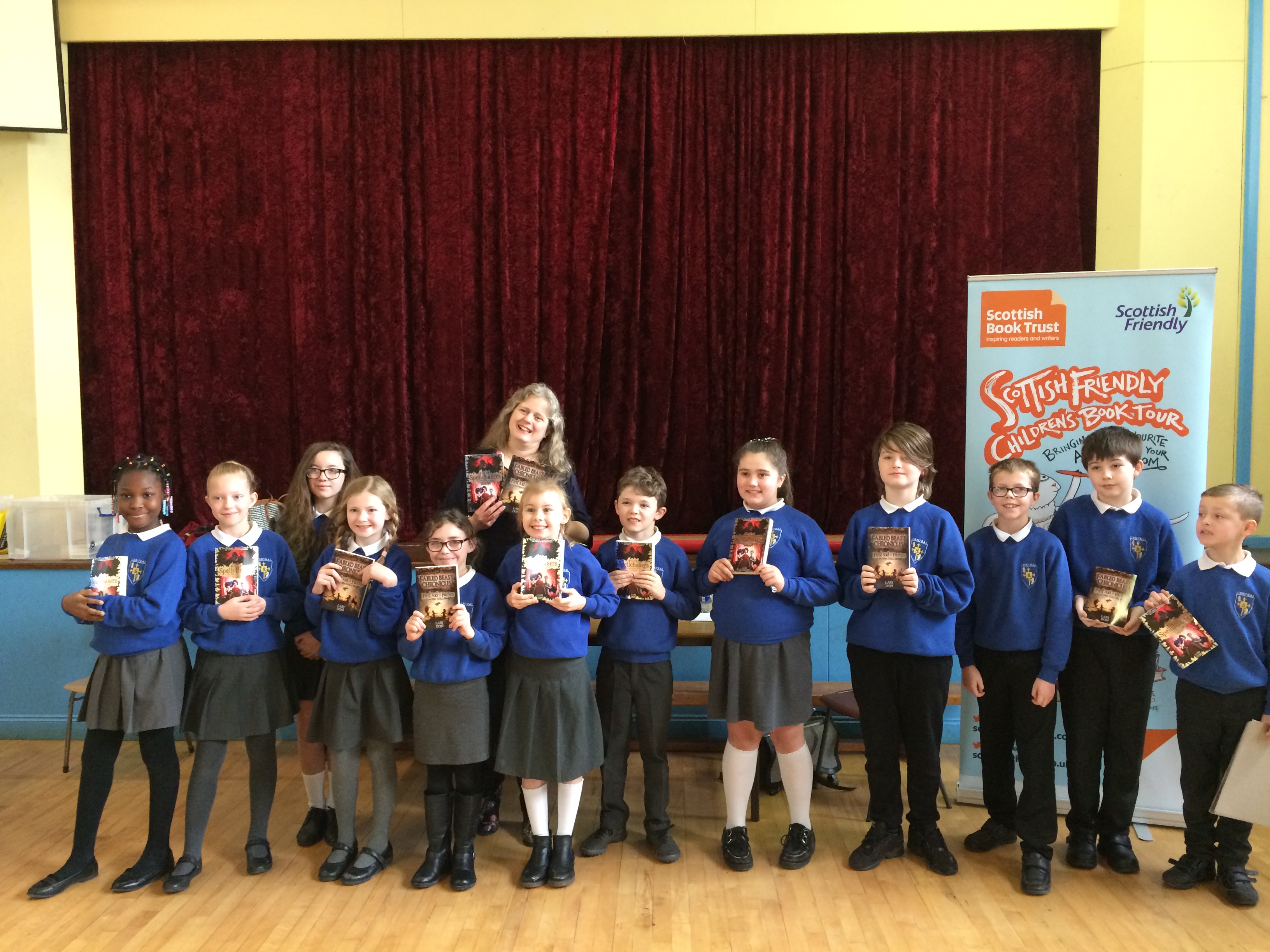
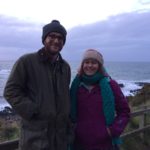 Tom and Beth of the Scottish Book Trust’s events team I’m just back from a week-long tour of Northern Ireland – the Scottish Friendly Children’s Book Tour, organised by the wonderful Beth and Tom of the Scottish Book Trust, with the help of Book Trust Northern Ireland. And I had a brilliant time!
I visited pupils from 13 different schools, in ten different events, ie two events a day from Monday to Friday. I read scenes from the first and sometimes the second Spellchasers books, and occasionally a bit of a Fabled Beast Chronicle too. I also chatted about how stories worked, and told a myth, legend or folktale in every school as well. I had a wonderful time in each school, and I can (almost) remember what we did in each session:
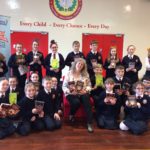 Holy Child Primary and St John’s Primary in Derry: our first school, so I took a risk and told a story about an Irish Celtic hero visiting Scotland. I got away with it, though it turns out I’ve been pronouncing Cuchullin wrong all these years… Holy Child Primary and St John’s Primary in Derry: our first school, so I took a risk and told a story about an Irish Celtic hero visiting Scotland. I got away with it, though it turns out I’ve been pronouncing Cuchullin wrong all these years…
Hollybush Primary in Culmore: This time I told a Scottish folktale, one I tell at home all the time, but it felt quite strange taking a Scottish story across the sea, almost like being an ambassador for Scottish trad tales! Also, it turns out that they don’t call potatoes ‘tatties’ in Northern Ireland…
St Joseph’s Primary in Dunloy: Their hall had a very echoey wooden floor and I was wearing very clunky boots, so after consulting the P4s (always wise people to consult) I took my boots off and did the whole session in my socks. I told a Viking myth, which meant that I got to be Loki in stocking soles and sneak around like a real god of mischief.
St Patrick’s Primary in Glenariff: they were reading Wolf Notes, and the hall was filled with wonderful pictures of wolves! (And centaurs…) Also, a pupil called Molly was our guide round the school, and she was remarkably relaxed about how badly I treat the Molly in Spellchasers…
St Comgall’s Primary in Antrim: This session started with a witch chasing a phoenix, and ended with an amazing Q&A session in which a P6 girl asked a question that I’ve never been asked before, and as I thought my way round an answer I found myself having an idea for a new novel while standing in front of 290 primary pupils…
Phoenix Integrated Primary in Cookstown and St Patrick’s Primary from Monymore: I couldn’t help myself. I was in a school called PHOENIX Primary, so I chatted to them about Catesby, the phoenix in Fabled Beast Chronicles, and we also come up with lots of exciting cliffhangers, not all of them about fiery birds!
Carrick Primary in Lurgan: The Carrick pupils created a story by trapping a tiger in a cage, but the tiger kept (almost) escaping. It was a relief that we reached the end of the story without anyone in the school getting eaten! Then, inspired by their tiger trapping, I told them a Hindu myth.
Templepatrick Primary and St Joesph’s Primary, Ballyclare: this was our biggest audience, with more than 300 children in one hall. They were incredibly well behaved and listened to each other’s ideas and questions so politely! We invented a chase in which a werewolf was trying to eat a rainbow elf. Did the elf get away safely? That’s the cliffhanger…
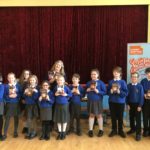 Lisburn Central Primary, Lisburn: I met some very imaginative pupils, who invented some great cliffhangers, and also come up with some very positive and cheerful endings for my favourite (but usually quite tragic) Viking myth. Lisburn Central Primary, Lisburn: I met some very imaginative pupils, who invented some great cliffhangers, and also come up with some very positive and cheerful endings for my favourite (but usually quite tragic) Viking myth.
And finally
St Mary’s Star of the Sea, Belfast: the very last school, with a very lovely warm welcome. (They brought us chocolate biscuits before we started…) It got a bit more dangerous once we started talking about stories, because we trapped a fairy godmother in a cave. With sharks. But it all ended happily, just like the tour!
I was asked wonderful questions in every single school. I can’t remember them all, because I concentrate on answering the questions, not scribbling them down. But I do remember the one which prompted a novel idea. And I’ll never forget the one which stumped me completely. Someone in the front row in St Patrick’s on Tuesday asked me:
‘If you had to kill one of Helen or Molly, who would you kill?’
I did try, but I just couldn’t answer it. So I wimped out and said I’d fight whichever baddie wanted me to make that choice, in order to give both my heroines time to get away…
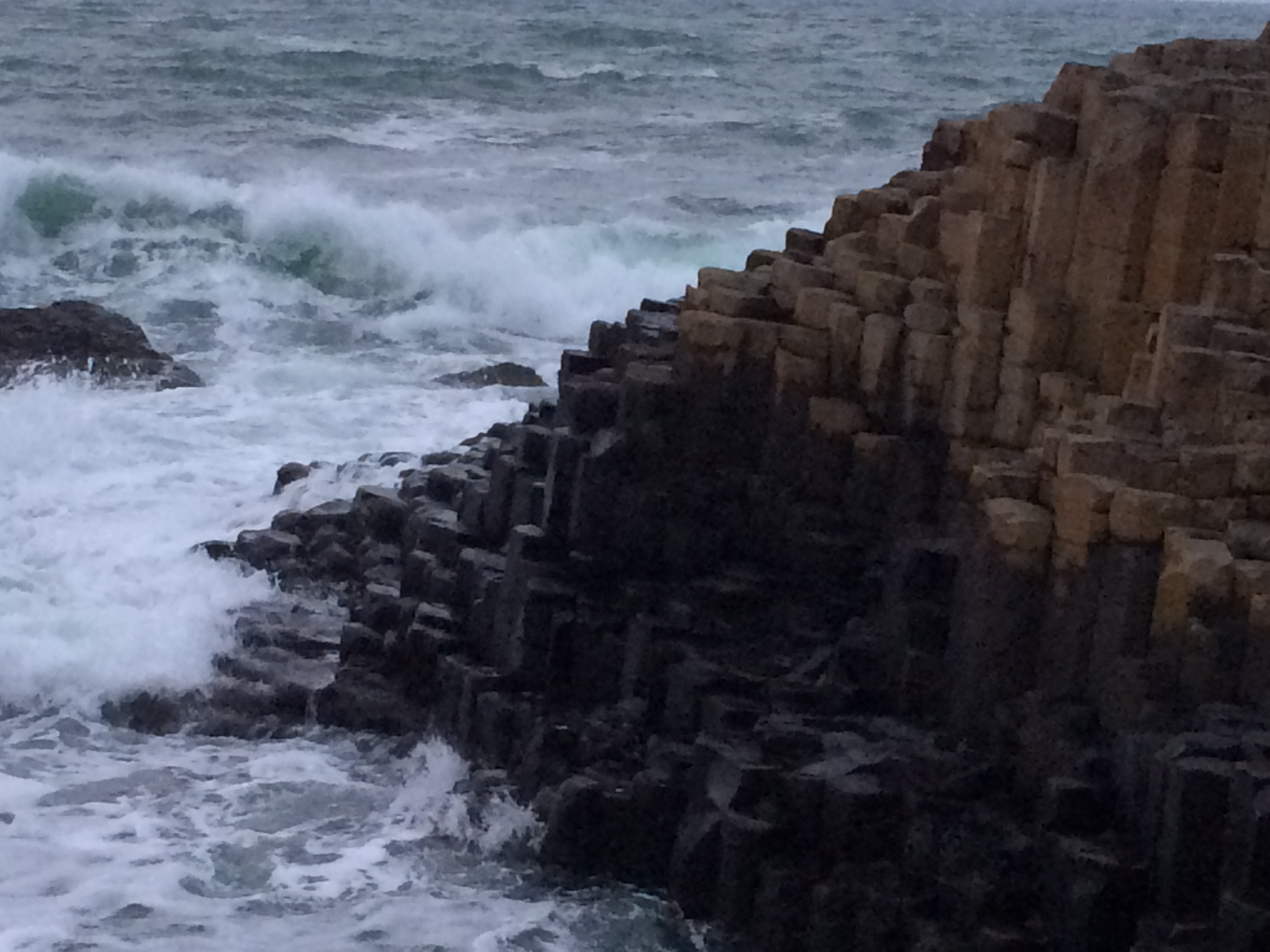
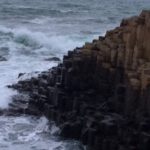 The ten school events were the highlights of the tour, but we managed a few out-of-school highlights too: The ten school events were the highlights of the tour, but we managed a few out-of-school highlights too:
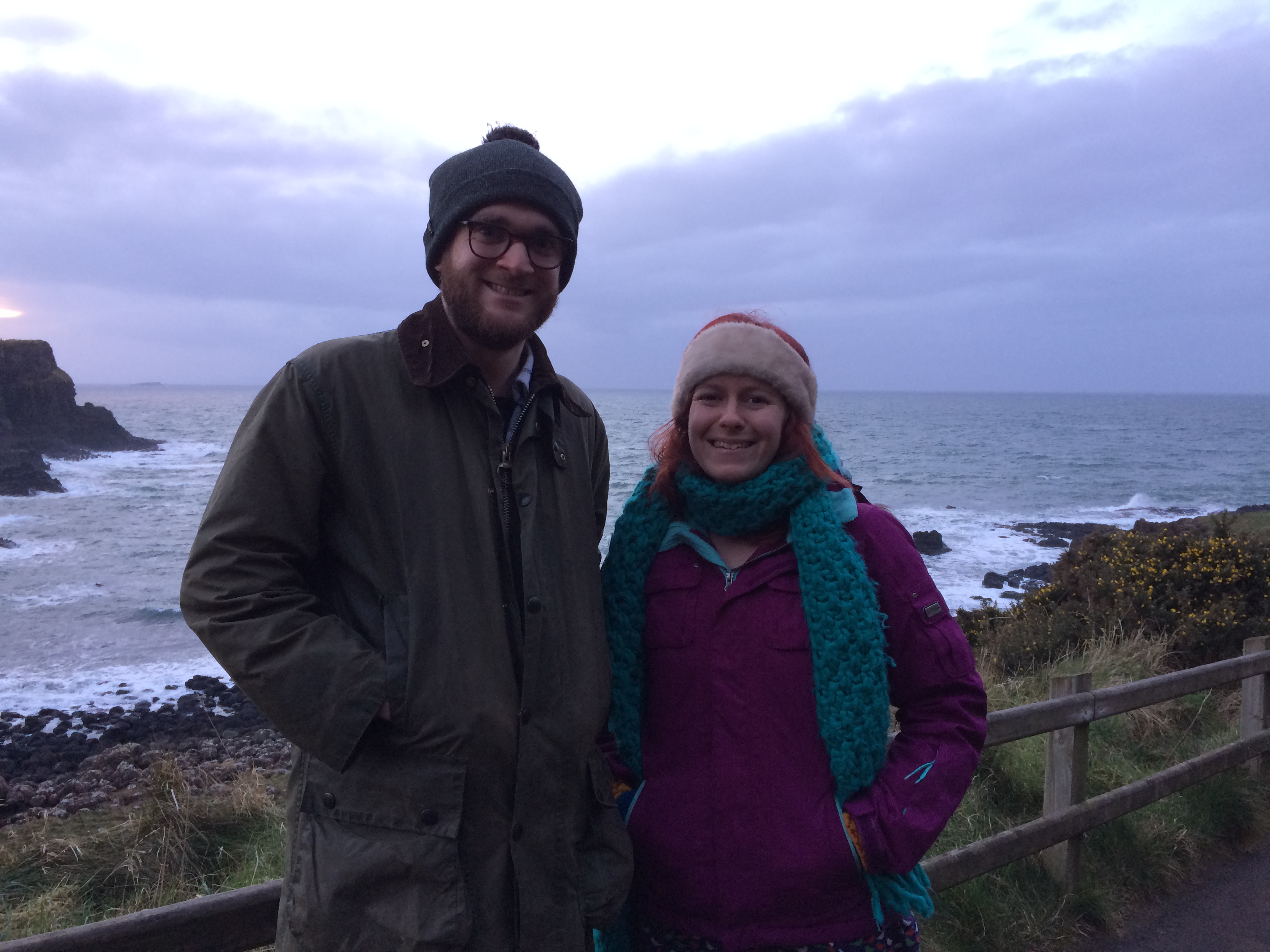
Beth, Tom and I visited the Giant’s Causeway one evening as the sun went down.
And I found a 1000 year old fort, all grown over with grass, on a night-time walk in a town called Moira, and scrambled over it in the dark and the rain. (That prompted a few story ideas too.)
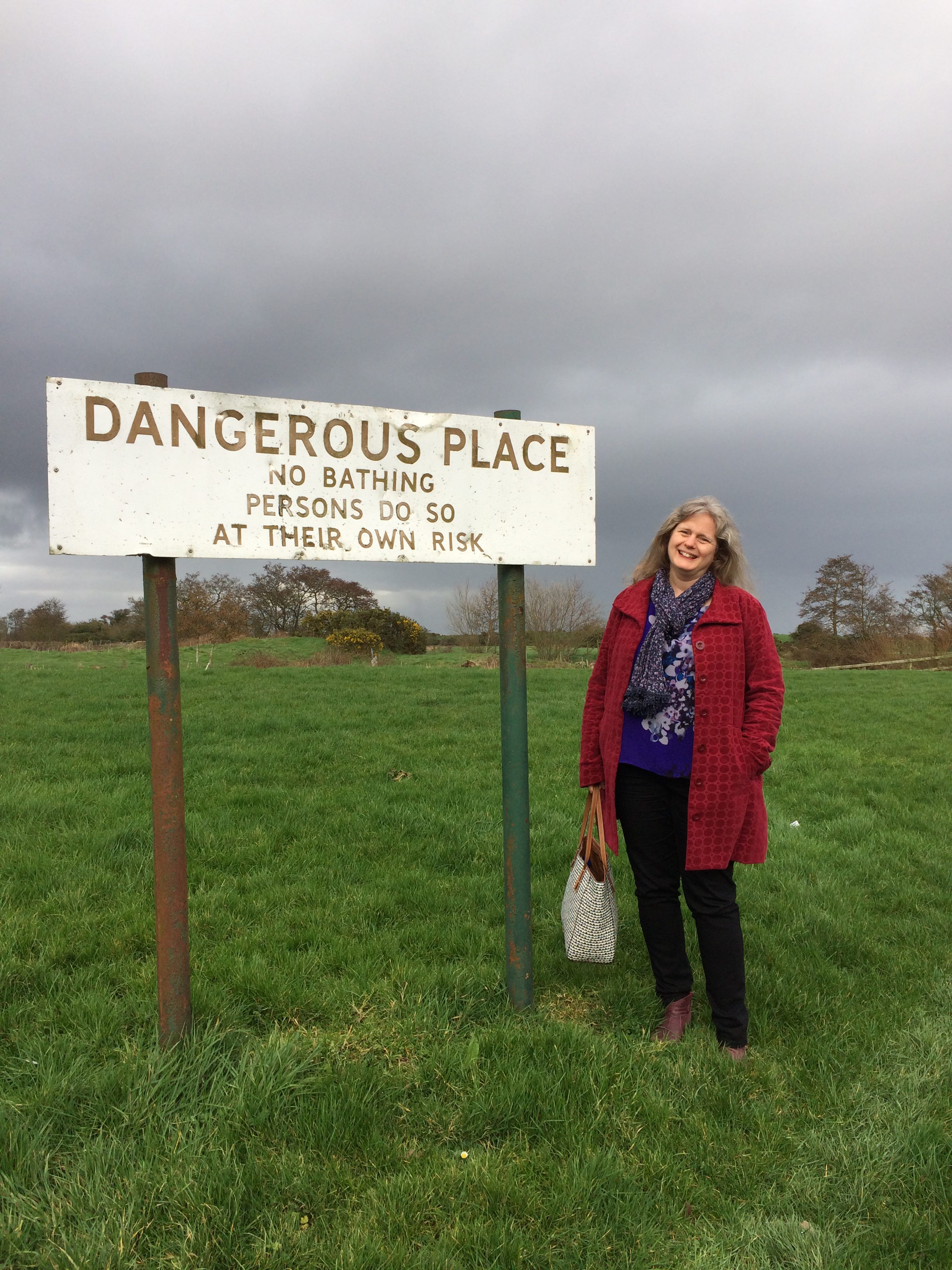
I must say that the Scottish Book Trust team were fantastic. Beth and Tom were extremely efficient and well organised, and looked after me very well (except when they took me to Dangerous Places) 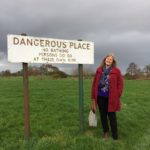 but they were also fun to spend 6 days with. We played several very serious games (or perhaps very silly games which we took very seriously) in the car. They taught me games involving actual horses and imaginary thimbles and I taught them one involving yellow cars. but they were also fun to spend 6 days with. We played several very serious games (or perhaps very silly games which we took very seriously) in the car. They taught me games involving actual horses and imaginary thimbles and I taught them one involving yellow cars.
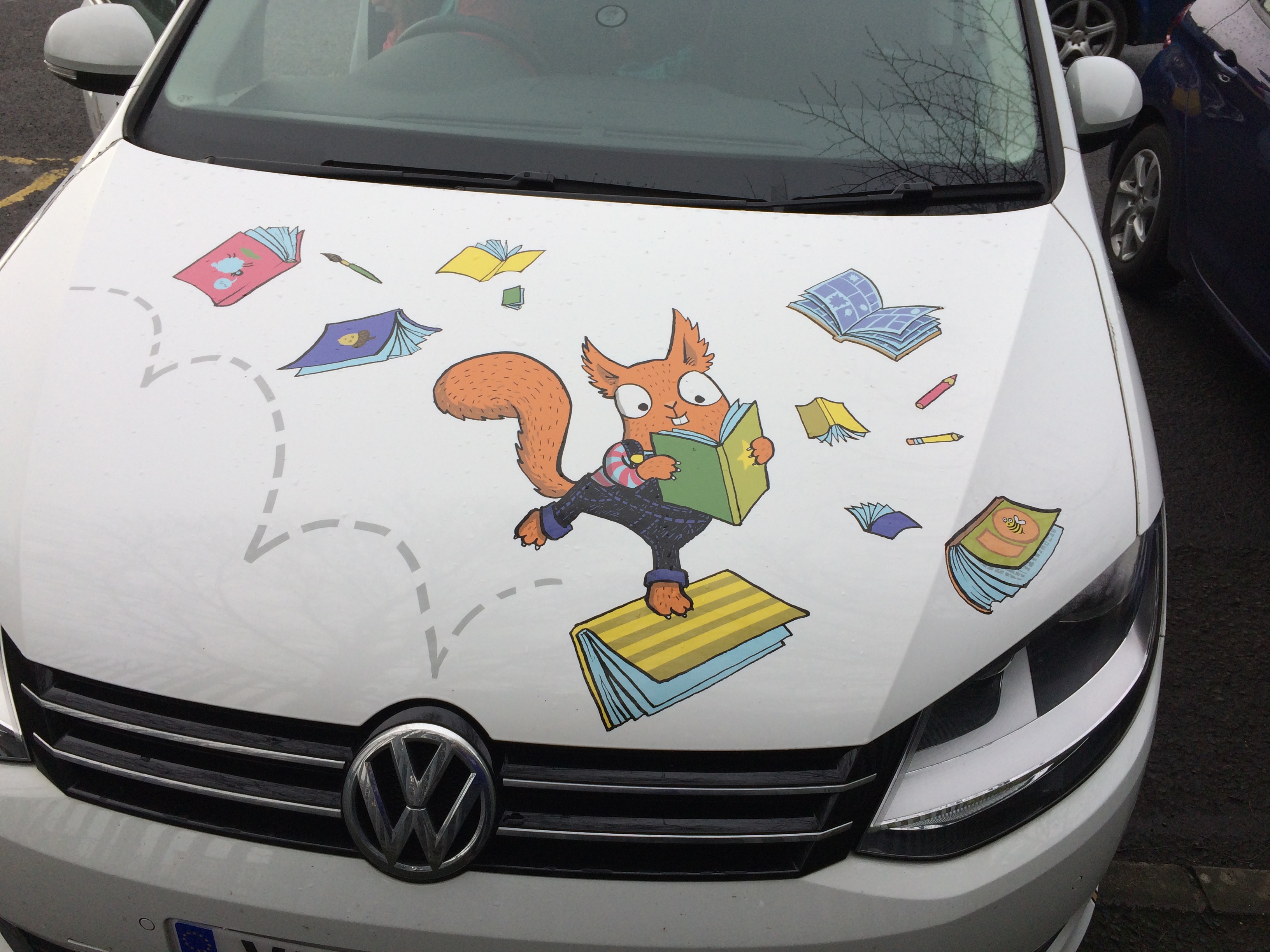
They drove me around in a big car (small van?) which left Edinburgh full of boxes of books, and by the time we headed home was almost empty. Which I’m sure will make my publishers happy.
 But the best thing about the van was the squirrel on the bonnet, and various other wonderful Scottish animals reading books painted on the sides – all created by the illustrator Sarah Macintyre. It was a lovely cheerful vehicle in which to visit all these villages, towns and cities. But the best thing about the van was the squirrel on the bonnet, and various other wonderful Scottish animals reading books painted on the sides – all created by the illustrator Sarah Macintyre. It was a lovely cheerful vehicle in which to visit all these villages, towns and cities.
And driving between the schools was wonderful, because Northern Ireland is very beautiful. It has lots of green fields and hills, but also dramatic glens and rocky coastlines.
It was a privilege to share stories with all those imaginative Northern Irish pupils, and to visit all their lovely welcoming schools. Thanks so much to everyone who put the tour together and who made it such a wonderful experience!
|
| Feb 01 |
Filled under: Events, Fabled Beast Chronicles, Mind Blind, Monsters (defeating!), Myths, legends, folklore, Novels, Readers, Spellchasers trilogy, trilogy, Uncategorized, Writing | by laridon |
I love riddles! And I don’t try to hide my love of riddles: I’ve put riddles in every single one of my novels so far…
I shamelessly used the Halloween guising scene in Mind Blind to slip in one of my favourite short riddles.
You to look at bit sideyways to find the riddle in Rocking Horse War.
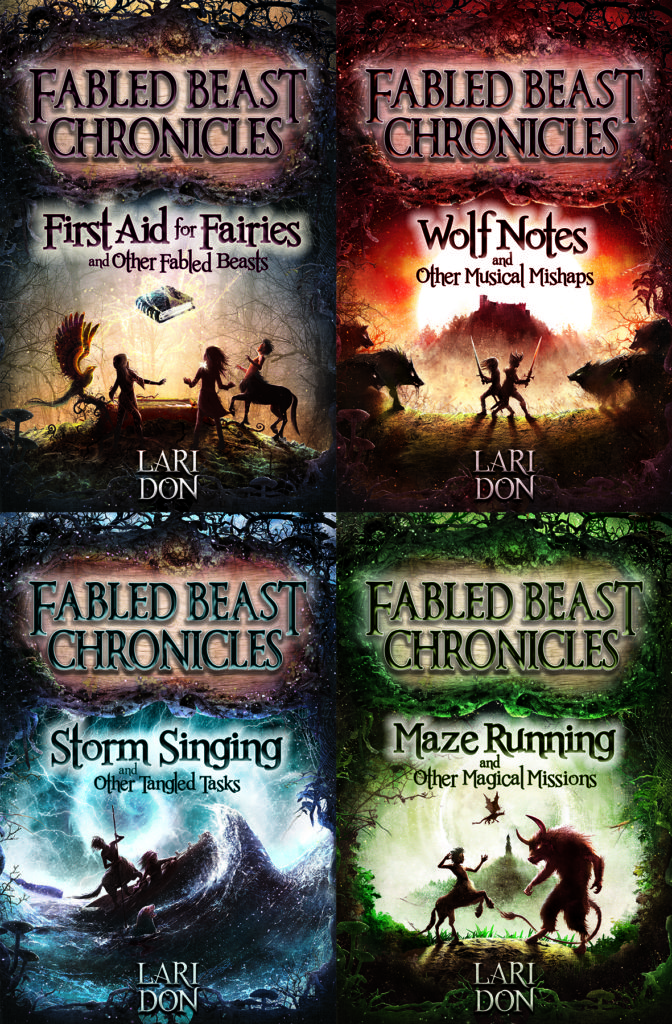 But riddles are an essential part of the plot of the Fabled Beast Chronicles, with the task of solving or matching riddles of some kind in every single one of Helen’s adventures. But riddles are an essential part of the plot of the Fabled Beast Chronicles, with the task of solving or matching riddles of some kind in every single one of Helen’s adventures.
And riddles are an even more important part of the Spellchasers trilogy, because they are an essential part of the life, job and self-image of one of the most important Spellchaser’s characters: Atacama the sphinx.
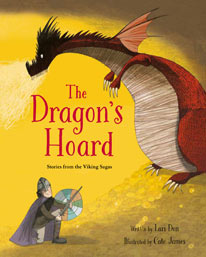
 I slip riddle tales into my folklore and legend collections too, like the Russian girl who solves the Tsar’s riddles in Horse of Fire, and Odin putting on a silly hat to solve a king’s riddles in Dragon’s Hoard… I slip riddle tales into my folklore and legend collections too, like the Russian girl who solves the Tsar’s riddles in Horse of Fire, and Odin putting on a silly hat to solve a king’s riddles in Dragon’s Hoard…
Where do all these riddles come from? In the folktale and legend retellings, I often use or adapt the original riddles. But for the novels, I always write original riddles. I could probably add riddle-writing to my CV now, I’ve written so many…
But why do I write them? There are so many fantastic riddles out there (I know because kids often bamboozle me with ones I haven’t heard!) so why do I make up new riddles?
Because the riddles need to fit the story. Sometimes the answers are linked to the plot, sometimes the riddles are designed to allow the characters (usually Innes…) to argue about the answers. Also, I want to surprise readers, rather than give them a riddle they might already know.
Also, honestly, I like inventing new riddles. There’s a satisfaction to it, an elegance and a logic that you usually only get with numbers. I sometimes call it maths with words – two of my favourite things together! (Yes, I love maths. I did maths at university. I love algebra and circles and straight lines and triangles and problem-solving… ) Also, one of my daughters is a riddle-master, and sometimes we collaborate on the riddles, which is great fun.

But I don’t just write riddles for books. Last autumn I wrote five new riddles for The Beginner’s Guide to Curses launch, and was very impressed at how fast all the young adventure fans answered them.
And now I’ve written three more riddles (with the help of Atacama, of course) for a competition run by my publishers to win a signed copy of the next Spellchasers novel: The Shapeshifters Guide to Running Away.
I wonder if you can answer them? Good luck…
(I might be doing a few riddle-writing workshops once Shapeshifter’s Guide is published, so keep an eye on my diary if you want to learn my riddle-writing secrets!)
|
| Jan 18 |
Filled under: Heroines and heroes, Monsters (defeating!), New Novel, Novels, Readers, Spellchasers trilogy, trilogy, Uncategorized, Writing | by laridon |
2017 is going to be a very Spellchasers year for me. It’s all going to be about Molly, her curse, her friends and, of course, her enemies. There will be a fair bit of shapeshifting, and a certain amount of magical combat.
2017 might even be more of a Spellchasers year than 2016, even though last year was the launch of the trilogy.
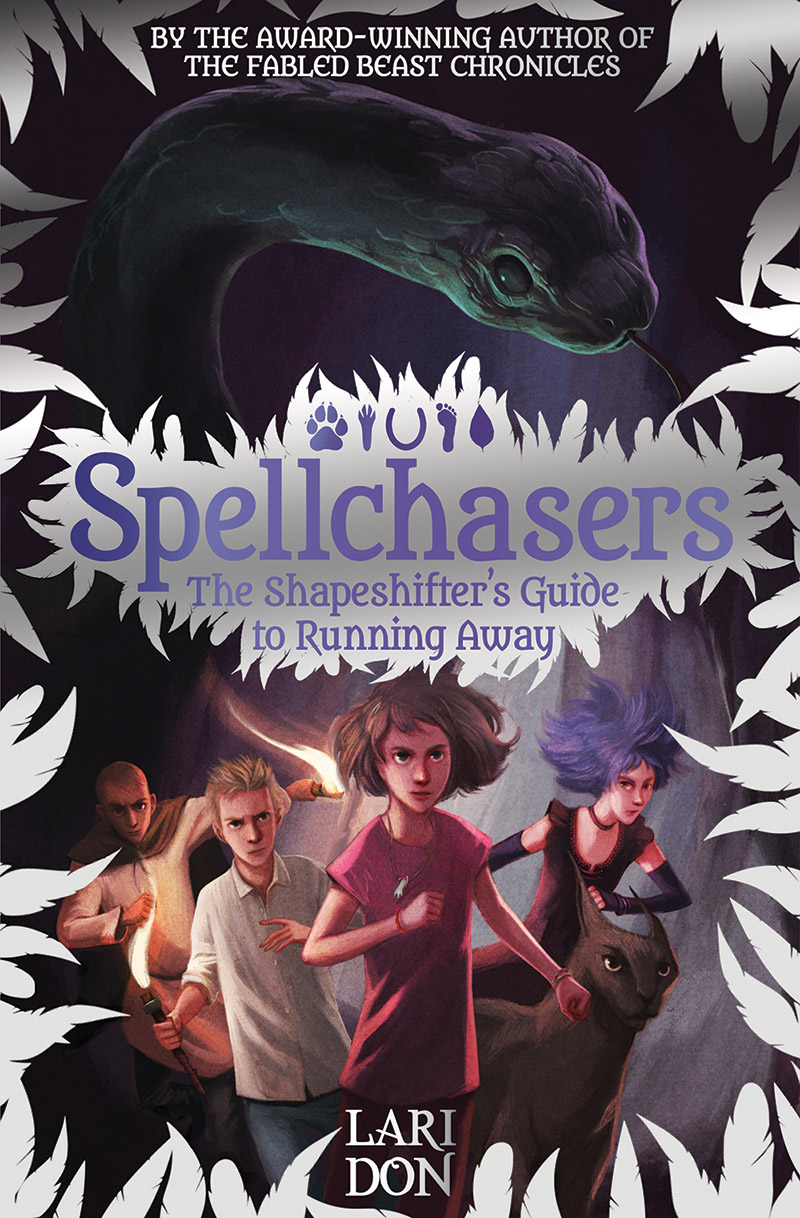
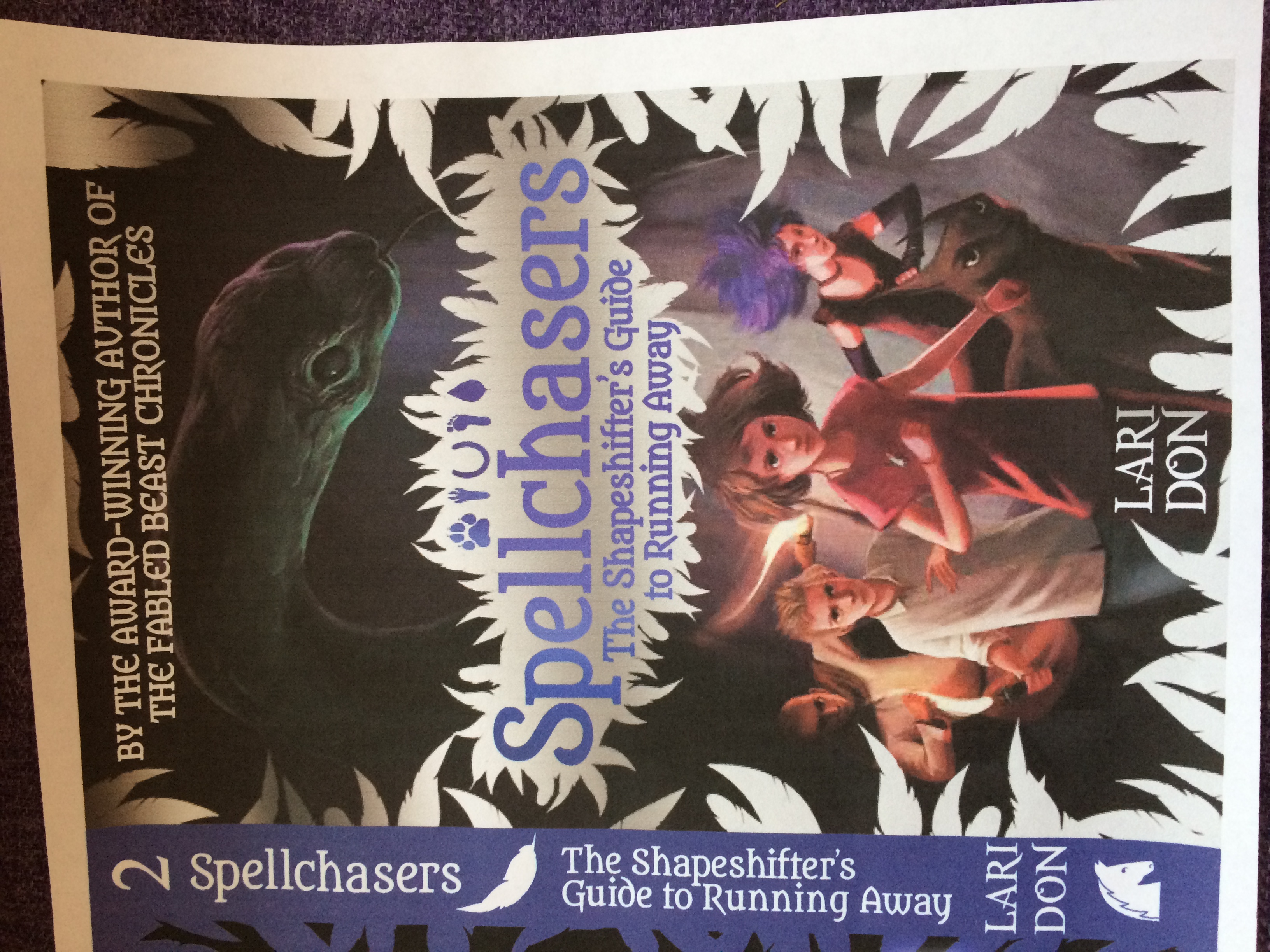
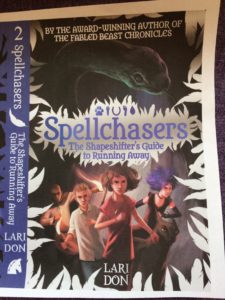 a sneak peek of the Shapeshifter’s Guide front cover and spine The second book, The Shapeshifter’s Guide To Running Away, is at the printers RIGHT NOW, and will be published next month, with an official launch the month after. (I’m getting quite excited!)
And I’m currently editing the third book, The Witch’s Guide To Magical Combat, which will head off to the printers just before the summer holidays and be published in early autumn.
So, for me, this will be a very Spellchasers year. And for anyone who wants to read about Molly’s adventures, there will be two new books and the chance to find out how her story ends!
And then…? Well, then the trilogy will be finished.
Readers have months to wait, and lots to read about, before they can find out how Molly’s story ends. But yesterday, while I was rereading and reconsidering the occasional verb in the final battle of Witch’s Guide, I suddenly realised that I’m nearly at the end of my journey with Molly and Innes and … everyone else (some of the ‘everyone else’s are characters that readers haven’t even met yet!)
I was reading a sentence in which Molly was walking towards danger, quite calmly, and I suddenly realised that I’m going to miss her. That she’s been a splendid heroine to work with, that I’ve had a great time with her, and that I’m going to miss having her in my head.
This sudden burst of emotion happened yesterday, ie in January, a whole 4 months before I proofread the third book for the last time, almost 8 months before it’s in the shops… But I’ve been writing about Molly and her magical world for more than 3 years now, and those very few months feel like I haven’t got much more imaginative time left with her. Soon, I’ll have finished creating and polishing her adventures, and she’ll be all yours!
Then I can start to write another adventure!
I’m looking forward to this Spellchasers year. I’m looking forward to finding out what readers think of Shapeshifter’s Guide to Running Away and of Witch’s Guide to Magical Combat. But I’m also looking forward to whatever I do next…
|
|
|
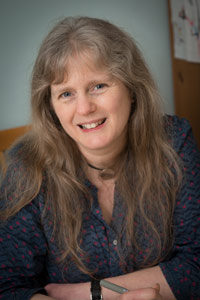
I’m children’s writer, and I write this blog mainly for children – readers, young writers, school classes, book groups etc, who want to understand how a writer writes. Everyone else welcome too though! And please do comment if you have any questions, or want me to blog about anything specific.
|
 So, I started reading more widely (getting to read lots as part of your job is one of the best things about being a writer) and I found a little snippet of folklore about treasure under the castle overlooking Loch Ness. I started to wonder about that treasure and the magic guarding it, and what Nessie’s connection might be to the treasure. Then I started to imagine some children who were prepared to take risks to get that treasure.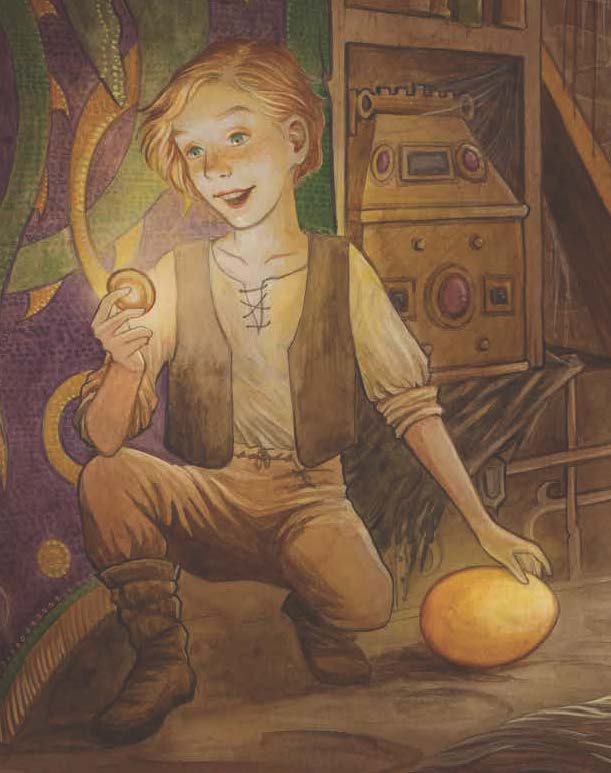
Recent Comments